Fineline Upholstery
Fineline Upholstery

Why Reupholstering Is Better for the Planet Than Buying New
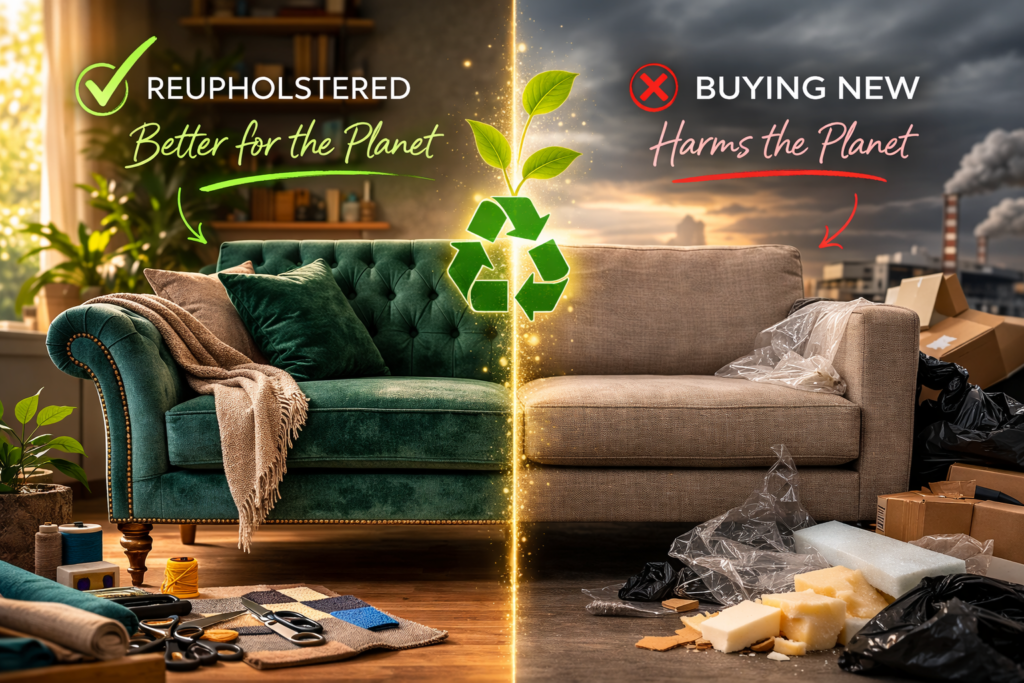
The furniture industry in the UK discards approximately 22 million pieces annually. The majority goes directly to landfill. This represents 670,000 tonnes of material, much of which is still functional. The environmental cost of this disposal practice extends beyond waste volume. Manufacturing replacement furniture requires raw material extraction, energy-intensive production processes, and long-distance transportation. Reupholstering existing furniture eliminates most of these environmental impacts. The process addresses the worn exterior while preserving the frame, internal structure, and the embedded resources those components represent. This article examines the actual environmental differences between reupholstery and replacement, using data from industry studies and waste management organisations.
The Scale of Furniture Waste in the UK
Climate action organisation WRAP estimates that 1.6 million tonnes of bulky waste is sent to landfill annually in the UK. Furniture accounts for 42% of this total. The North London Waste Authority reported that over 22 million individual furniture pieces are discarded each year.
What makes these figures more significant is the proportion of discarded furniture that remains functional. WRAP’s research found that 32% of bulky waste is re-usable in its current condition. When items requiring slight repair are included, that figure rises to 51%. At Household Waste and Recycling Centres specifically, approximately 110,000 tonnes of furniture is assessed as re-usable without modification.
Consumer behaviour data: A 2025 survey conducted by Censuswide found that 25% of UK adults replace a piece of furniture at least once per year. Nearly 1 in 10 replaces furniture annually. This replacement rate has increased alongside the growth of what is now termed ‘fast furniture’ mass-produced items manufactured from lower-cost materials and designed to match short-term aesthetic trends rather than long-term durability.
Less than 1 in 10 people consider repairing furniture to extend its lifespan. The default response to wear or style change is replacement, not restoration.
Fast Furniture and Material Lifespan
Fast furniture is manufactured using chipboard, fibreboard, plastic components, and synthetic foam. These materials reduce production cost but also reduce structural integrity. Industry data indicates that fast furniture typically lasts 5 to 7 years before requiring replacement. Quality furniture constructed from solid wood frames with traditional joinery and hand-tied springs can be expected to last 10 to 20 years in active use, and significantly longer with periodic reupholstery.
The difference is structural. Older furniture frames are constructed from kiln-dried hardwood oak, beech, or ash using traditional wood joinery techniques such as mortise and tenon and dovetail joints. Modern mass-produced furniture substitutes these materials with engineered wood products held together with mechanical fasteners and adhesive. The frame degrades under normal use conditions and cannot be economically repaired.
This is not an aesthetic preference. It is a measurable difference in material durability and reparability. A solid hardwood frame that can be reupholstered three or four times over 40 years represents a different resource equation than particleboard furniture replaced every 6 years.
Carbon Footprint: New Furniture vs Reupholstery
Furniture production generates carbon emissions at every stage. Raw material extraction, manufacturing, finishing processes, packaging, and transportation all contribute to the total footprint. Research from multiple sources provides consistent data on the scale of these emissions.
Carbon emissions from new furniture: A 2022 assessment by the UK furniture industry body FIRA found that the industry’s carbon footprint exceeded 575,000 metric tonnes. The estimated average carbon footprint for a new task chair was measured at 72 kgCO₂e. A standard workstation desk measured 45 kgCO₂e. For reference, 72 kgCO₂e is equivalent to burning approximately 8 gallons of petrol.
Carbon emissions from reupholstery: Data compiled by office furniture recycling specialists in 2025 estimates reupholstery emissions at 2 to 3 kgCO₂e per item. This accounts for fabric production, foam replacement where required, and the labour-intensive restoration process. Component replacement swapping mechanisms, castors, or structural elements adds 3 to 5 kgCO₂e. Even when multiple refurbishment processes are applied, the total emissions remain a fraction of new production.
Comparative reduction: The KTH Royal Institute of Technology in Sweden studied the lifecycle impacts of furniture reuse and determined that buying used or refurbished furniture reduces climate impact by 42% compared to purchasing new. With improved logistics and better material choices in the second-hand sector, that figure could reach 80%. A separate study examining university furniture procurement found that reusing furniture eliminates between 85% and 97% of emissions compared to buying new equivalents.
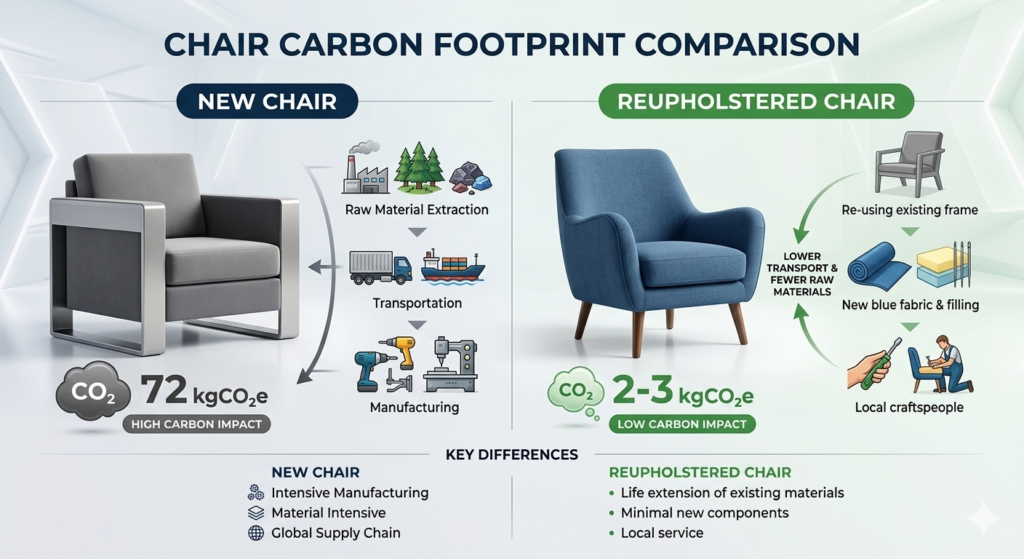
Research from RISE, the Research Institutes of Sweden, concludes that circular use of furniture repair, refurbishment, reupholstery reduces the carbon footprint by 20 to 40% compared to linear consumption patterns where items are used once and replaced.
Where Environmental Impact Occurs in Furniture Production
Multiple lifecycle assessments of furniture production identify the same pattern: the majority of environmental impact occurs during pre-manufacturing and raw material extraction. Manufacturing and assembly processes contribute additional emissions, but these are secondary to the resource extraction stage.
Wood harvesting, metal mining, and plastic production are energy-intensive. Transportation of raw materials to manufacturing facilities, often across continents, adds further emissions. Finishing processes; staining, varnishing, foam treatment frequently involve volatile organic compounds and other chemical releases.
Scale of raw material use: The global furniture industry uses an estimated 100 million trees annually. Demand for low-cost timber drives illegal logging, which accounts for up to 30% of global timber trade according to World Wildlife data. The consequences extend beyond carbon emissions to include habitat destruction and biodiversity loss.
Reupholstery eliminates the pre-manufacturing and raw material extraction stages entirely. The frame, springs, and structural padding already exist. The only new materials required are fabric, replacement foam if the existing padding has degraded, and thread. The environmental cost is limited to these specific inputs rather than the full production chain.
Chemical Treatments and Material Composition
Mass-produced furniture frequently contains chemical treatments applied during manufacturing. Flame retardants particularly polybrominated diphenyl ethers (PBDEs) are applied to foam and fabric to meet fire safety regulations. Perfluorinated compounds (PFAs) provide stain resistance on upholstery. Formaldehyde is used in engineered wood products and leather tanning processes.
These substances do not remain inert. They off-gas over time, contributing to indoor air quality issues, and they leach into soil and groundwater when furniture is landfilled. Regulations have tightened in recent years, but legacy furniture already in circulation and items imported from jurisdictions with less stringent standards continue to pose concerns.
Reupholstery allows control over material selection. Clients can specify untreated natural fibres, low-VOC foams, and fabrics certified under environmental standards. This option is not available when purchasing mass-produced furniture where material composition is predetermined and often undisclosed.
Longevity and Total Resource Use
The environmental case for reupholstery becomes clearer when viewed across the full lifespan of a furniture piece. A solid hardwood sofa frame manufactured in the 1960s or 1970s can be reupholstered multiple times. Each reupholstery extends its functional life by another 10 to 15 years.
Compare this to the replacement cycle of contemporary mass-produced furniture. If a sofa lasts 6 years before structural failure, a household will require multiple replacements over a 40-year period. Each replacement carries the full environmental cost of raw material extraction, manufacturing, transportation, and eventual disposal.
Total resource equation: One quality sofa reupholstered three times over 40 years versus six or seven mass-produced sofas replaced during the same period. The accumulated material use, energy consumption, and waste generation are not comparable.
Barriers to Reupholstery and Furniture Reuse
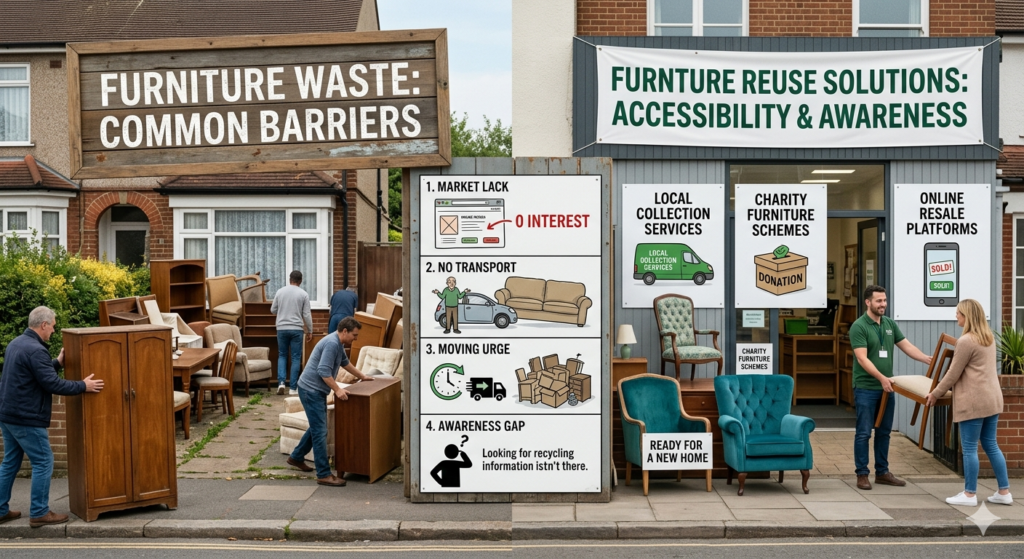
If the environmental and economic case for reupholstery is clear, why does furniture waste continue at current levels? The Censuswide survey data provide some explanation. The most common reasons UK adults gave for discarding functional furniture rather than selling, donating, or repairing it were:
- Unable to find a buyer or insufficient interest (17%): The second-hand furniture market exists but requires time and effort to access.
- Lack of adequate transport (16%): Moving large furniture items to donation centres or buyers requires vehicle access.
- Urgency of moving or relocation: Time constraints during house moves lead to furniture being discarded rather than properly rehomed.
- Lack of awareness of recycling programmes: Many people are unaware that furniture reuse and recycling infrastructure exists in their area.
These are practical obstacles, not insurmountable barriers. Local authority collection services, charity furniture schemes, and online resale platforms address some of these issues, but awareness and accessibility vary by region.
What Reupholstery Preserves
Beyond environmental metrics, reupholstery preserves construction quality that is difficult to source in contemporary furniture markets. Hand-tied coil springs provide superior support and longevity compared to sinuous wire springs or elastic webbing used in modern seating. Solid hardwood frames withstand stress and weight loads that engineered wood cannot match. Traditional padding materials; horsehair, coir & cotton felt will maintain their integrity over decades.
These construction methods are labour-intensive and therefore cost-prohibitive in mass production. Furniture manufactured to this standard is available, but it is priced accordingly. Reupholstering existing quality pieces of furniture provides access to this high level of construction at a fraction of the cost of equivalent new furniture.
What We Recommend at Fineline Upholstery
We assess every piece of furniture that comes into the workshop on the same criteria: frame integrity, spring condition, and whether the structure justifies the reupholstery cost. Not all furniture is worth restoring. Particleboard frames, stapled joints, and degraded foam padding in cheaply constructed pieces cannot be economically repaired.
Where the frame is sound solid hardwood construction with proper joinery, reupholstery extends the furniture’s life substantially. We replace worn fabric, restore or replace padding materials, retighten springs where required, and address any structural wear in the frame itself. The result is furniture that performs as it did when originally manufactured.
Environmental considerations: Clients increasingly ask about the environmental impact of their furniture decisions. The data supports reupholstery as the lower-impact option in cases where the existing frame has structural integrity. The carbon footprint of reupholstery is a small fraction of new furniture production, and the process keeps functional materials out of landfill.
For furniture that cannot be economically reupholstered, either because the frame is failing or the cost would exceed replacement, we advise clients honestly. Reupholstery is not always the appropriate choice. When it is appropriate, it typically represents better value and lower environmental impact than replacement.
If you are considering reupholstery and are uncertain whether your furniture is suitable for such a process, we can assess the piece and provide clear guidance. Send us photos or even bring the item itself, and we will explain what is possible, what the process involves, and whether it makes sense in your specific situation.
Our Services
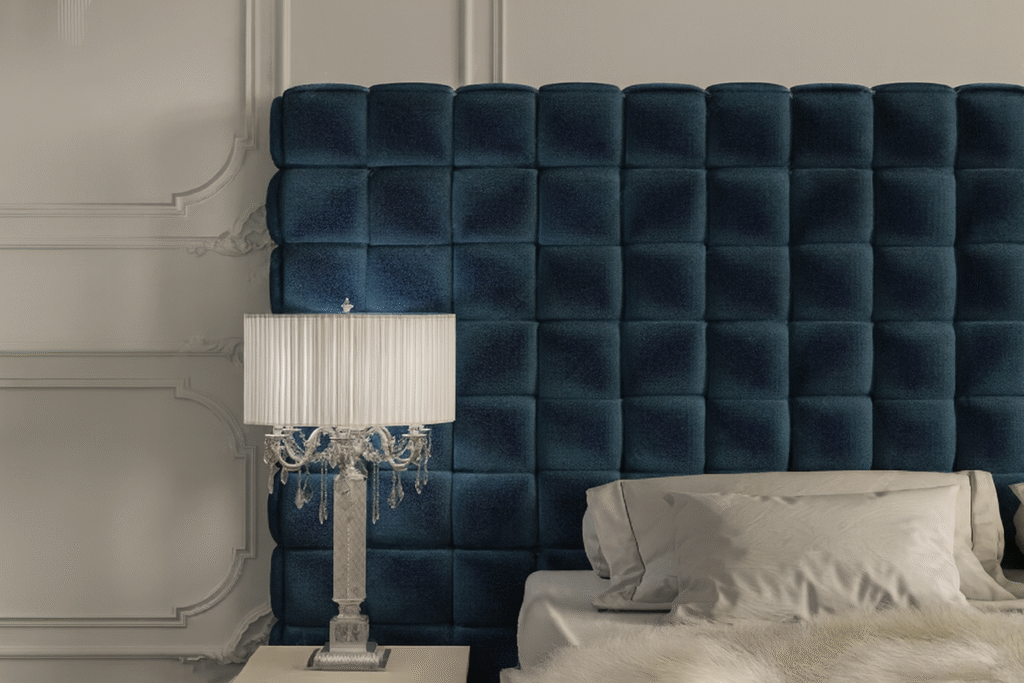
Headboards/ Bedframes
Bespoke Loose Covers
Commercial Upholstery
Curtains & Blinds
Bespoke Upholstery
Bespoke Cushions
EXCELLENTTrustindex verifies that the original source of the review is Google. Fineupholstery are wonderful. I have used their services before. I took in an old and very interesting chair for them to re-cover. It was quite complicated and they have done an excellent job. I am thrilled with the new look. And they were so helpful with fabric choice. I felt looked after and will happily to continue using their expert recovering services again. Thank you to all.Posted on GoogleTrustindex verifies that the original source of the review is Google. I contacted Fineline Upholstery to ask for some help with a damaged sofa. They were very prompt, asked for all the necessary details in one email so that once that was provided they could provide a quote and then come and carry out the work. It was effortless and I am very happy with their speed and professionalism. I would definitely use them again.Posted on GoogleTrustindex verifies that the original source of the review is Google. Excellent service and beautifully reupholstered armchair. Top job from beginning to end. Thank you!Posted on GoogleTrustindex verifies that the original source of the review is Google. Friendly, reliable and excellent craftsmanship! Thanks v much :) love our “new” furniturePosted on GoogleTrustindex verifies that the original source of the review is Google. It’s not just the quality of the upholstery, which is absolutely outstanding, but also the excellent customer service. All done really efficiently with updates at every stage.Posted on GoogleTrustindex verifies that the original source of the review is Google. It was a pleasure dealing with Fineline Upholsterers. Their work is of the highest standard and we were delighted with their speedy, prompt and excellent service. I would highly recommend them.Posted on GoogleTrustindex verifies that the original source of the review is Google. I dumped a whole pile of unsatisfactory sofa seat cushions in the workshop. 2 weeks later they were delivered home all pristine and plumped. So easy. So efficient. I can’t wait for my next project!Posted on GoogleTrustindex verifies that the original source of the review is Google. Highly recommended! Fineline Upholstery could not have done more to help. We had a bed that unfortunately got damaged during a house move. Collection, return and reassembly were all carried out efficiently and professionally. The quality of the reupholstered bed could not have been better. We will certainly use again.Posted on GoogleTrustindex verifies that the original source of the review is Google. Excellent service courteous and extremely efficient. Thank you Min. Delighted with the cushions beautifully made and ready much earlier than expected. Thank you Chris.Posted on GoogleTrustindex verifies that the original source of the review is Google. Can’t recommend this company highly enough! Have now used them twice: re-padding and re-upholstery of antique dining chairs and re-upholstery of new chaise. The results were brilliant, excellently made and the customer service responsive, attentive and very efficient. Prices are fair and reasonable. Thankyou!


Our Location
Address: 63 New King’s Road, Fulham, London, SW6 4SE
Opening time:
Monday – Friday: 9:00am – 5:00pm
Saturday: 9:00am – 4:00pm
Sunday: Closed
Speak with the Team
020 7371 7073
info@finelineupholstery.co.uk
