Fineline Upholstery
Fineline Upholstery

Understanding the Reupholstery Process: Why Custom Work Takes Time and Craft
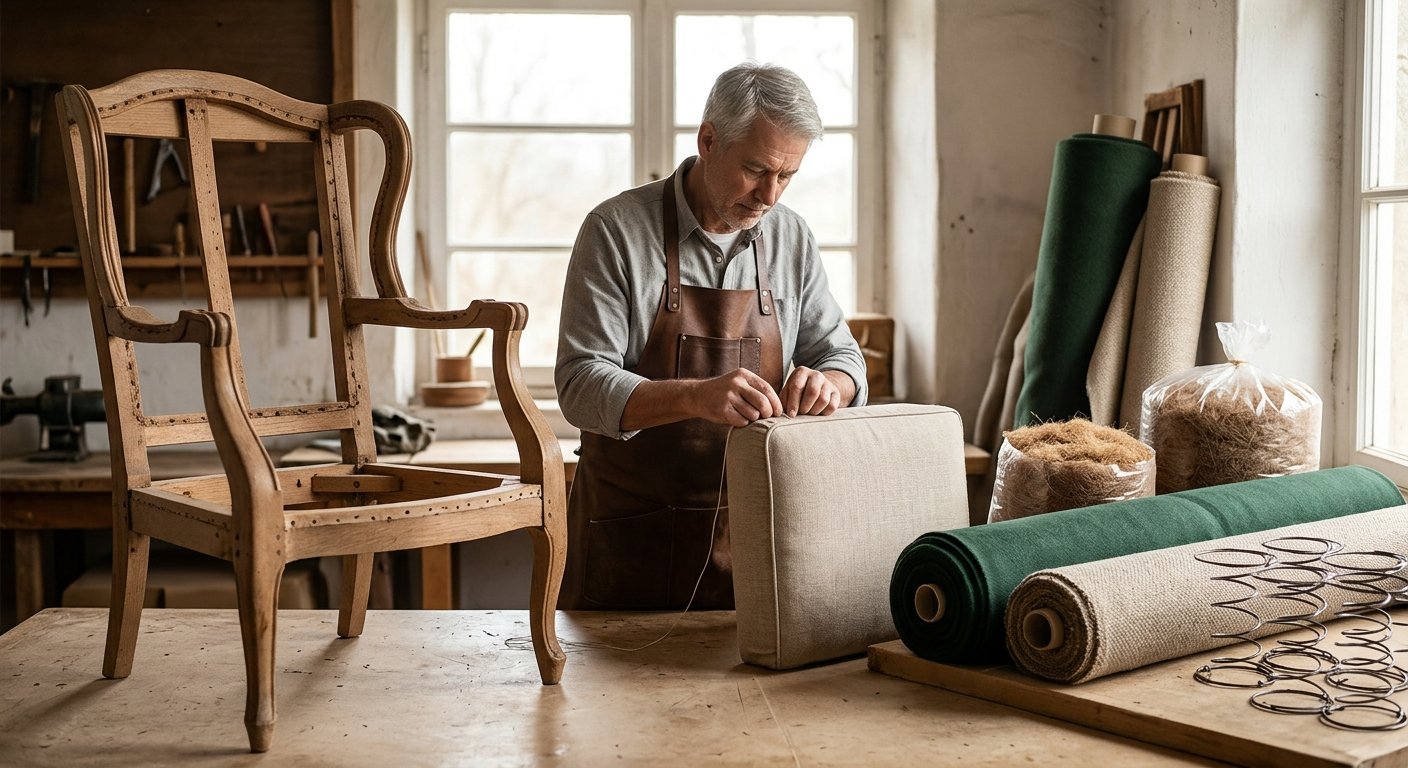
In almost every reupholstery enquiry, how long the transformation will take is one of the very first questions we are asked. It is a completely natural concern, but the turnaround time simply reflects the meticulous and intricate nature of the craft itself. Reupholstering a piece isn’t about assembling off-the-shelf components; it’s a dedicated process applied to furniture that has already lived a full life. Until we carefully strip away the original fabric, the true story and work required beneath remains hidden, requiring an individual approach that simply cannot be rushed.
This article sets out the phases a piece passes through in a workshop, from assessment to completion, and what happens in between. By thoroughly sharing this descriptive timeline, we hope to shed light on everything that goes into the bespoke craft that an upholstery project requires.
What the Timeline Actually Looks Like
The specification of time periods is a good place to start. Bench time relates to the hours a piece is actually being worked on. Lead time is the period between the first enquiry and the furniture returning to the client. These figures are never the same, and most of the confusion about reupholstery timescales comes from treating them as though they were.
Published figures from UK workshops give a consistent picture. One workshop reports a lead time of around four to six weeks from initial enquiry to re-delivery, with the workshop process itself usually taking around two weeks once the furniture has been collected. Another describes a three- to four-week wait before collection can be scheduled, followed by completion within fourteen working days. A UK trade guide puts workshop lead times at four to twelve weeks depending on current work schedule and fabric availability, with the physical work taking three to five days for chairs and one to two weeks for large sofas.
The pattern is clear enough. Bench time for a single chair is usually measured in days and for a sofa in weeks, while the overall lead time is measured in weeks or occasionally months. The gap between the two is taken up by the workshop queue, the fabric order, and scheduled collection and delivery, none of which can be compressed by working faster at the bench.
Bench time is not lead time. A chair may take three to five days of actual work, yet still be quoted at six weeks from enquiry to return. The difference is the workshop queue, the fabric delivery, and collection scheduling. A workshop that promises a very short lead time is usually either working with stock fabric or has no queue, and neither is necessarily an advantage.
Assessment and Quotation
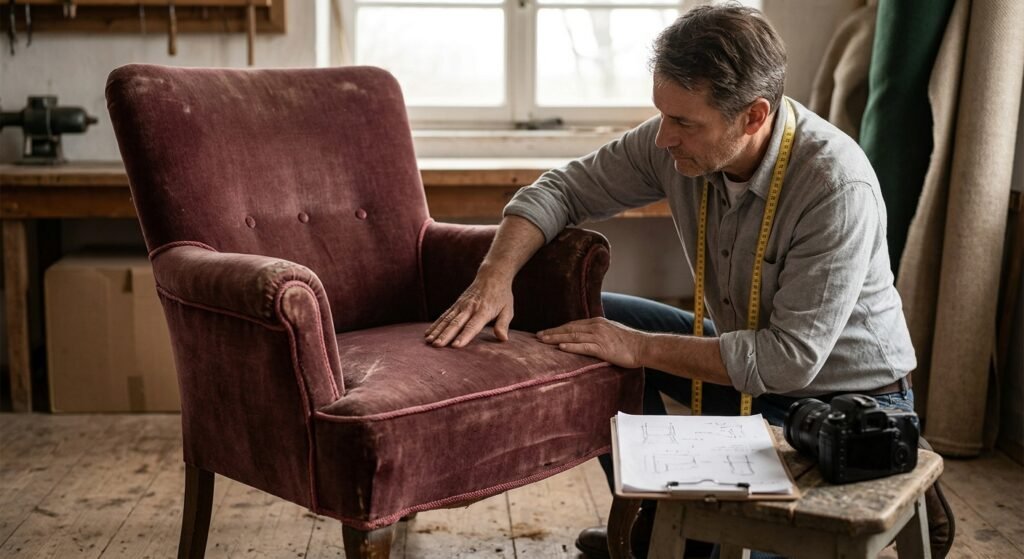
The process begins with an assessment. This can often be done from photographs for simpler pieces, though larger or more complex items generally benefit from being seen in person. The upholsterer is looking at the style and construction of the piece, the number and type of cushions, the presence of buttoning, piping, trims or studwork, and any visible signs of structural movement or damage that may require repair.
A quotation given at this stage is based on what can be seen. This type of assessment covers most of the work, but it is an assessment rather than a certainty. Frames, springs, and old repairs are concealed by the existing upholstery, and their condition can only be confirmed once the piece is stripped. Most workshops handle this by quoting for the expected work and agreeing to discuss anything unexpected before proceeding, rather than by building a contingency into every price.
Tear-Down: Removing Everything Back to the Frame
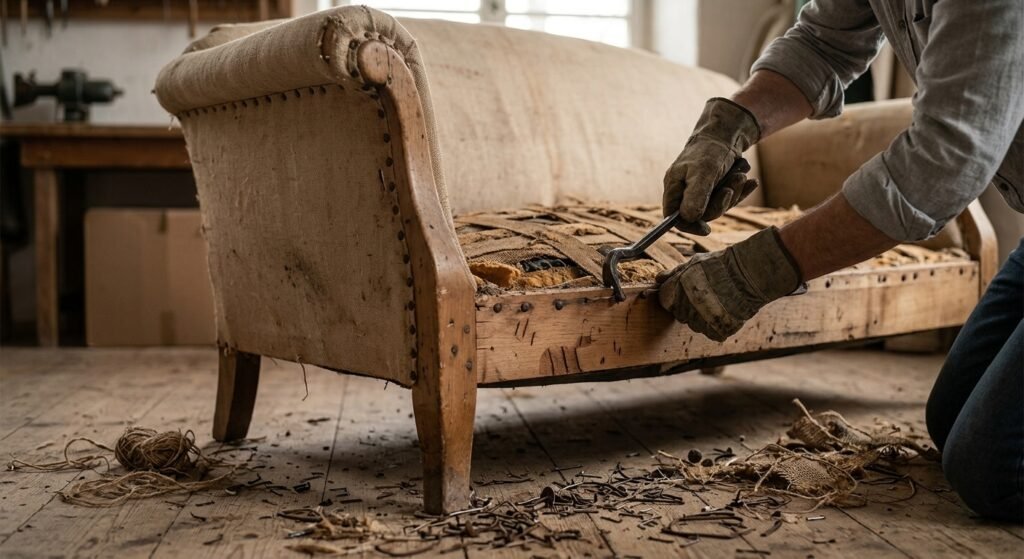
Reupholstery begins by taking the piece apart. The old fabric, wadding, stuffing, and fixings are removed in sequence until the frame is bare. On older pieces this means drawing out tacks one at a time; on later pieces it means removing staples, of which there can be a great many. The work is slow, it cannot be rushed without damaging the frame, and it produces nothing visible. It is also the point at which the piece can first be properly assessed.
What appears at this stage varies. Previous reupholstery is common on older furniture, and the quality of that earlier work may not always be of high quality. Frames may carry old repairs, screws driven into split rails, or joints that have been glued more than once. Webbing may have perished, stuffing may have broken down or migrated, and foam that looked serviceable can turn out to be crumbling. Tack and staple damage accumulates with each previous recovering, and on a frame that has been worked several times there may be limited sound timber left to fix into.
Serious structural surprises are not common. One UK workshop puts hidden structural issues at fewer than 0.1 percent of projects. That figure is worth keeping in perspective: in the large majority of cases, the piece is broadly as expected. A big part of completely stripping a piece down before the frame is signed off for reupholstery to begin is that serious structural flaws cannot be identified without taking the piece back to the frame.
Frame Inspection and Repair
With the frame bare, joints are checked for movement, timber is checked for splits, and any woodworm damage or previous repair work is assessed. A frame in sound condition needs little more than cleaning and minor attention. A frame with loose joints needs those joints taken apart, cleaned of old adhesive, re-glued, clamped, and left to set and stabilise. Where a rail is split or broken beyond repair, it is replaced; industry guidance puts the cost of replacing a broken rail in the region of £100 to £200, though this varies with the piece and the workshop.
Frame work introduces waiting time that no amount of labour can shorten. Adhesive needs to set under clamp pressure before the frame can take webbing, springs, or any working load. A frame repaired in the morning is generally not ready to build on the same afternoon. This is one of the points where a compressed schedule causes real problems, because a joint that has not fully bonded will move again under use.
Frame quality also determines whether the work is worth doing at all. Kiln-dried hardwood frames with mortise and tenon or dowelled joints can be repaired and reupholstered repeatedly across decades. Particleboard and stapled softwood frames generally cannot be economically repaired, because there is nothing sound to fix into and the material degrades under normal use. This assessment is made at the frame stage and is the point at which a client may be advised that the piece does not justify the work.
Suspension: Webbing and Spring Work
The suspension system sits directly on the frame and carries the weight of anyone who uses the piece. It must be reconstructed before anything else can be done. Webbing is stretched and fixed under tension across the frame, and where the piece is sprung, the springs are stitched to that webbing and then fused together with laid cord so that they compress as a unit rather than independently.
In traditional eight-way hand-tied work, each coil is tied in eight directions: front to back, side to side, and across both diagonals, which is where the name comes from. The system distributes weight evenly across the seat and recovers its shape after compression and can be expected to last decades, with retying possible when it eventually slackens. Traditional seat construction is a meticulous and time-consuming process, the labour involved is the reason it is rarely seen in mass-produced furniture. Sinuous springs, which are pre-formed and clipped to the frame, are considerably quicker to fit and give acceptable support on a sound frame, though generally do not provide the same longevity.
Which method a piece receives is usually determined by how it was originally built rather than by preference. A frame designed for hand-tied coils is rebuilt that way, and the time taken is a necessary and unavoidable consideration to account for.
Building the Layers
Once the seat section is sound, the piece is built back up in layers. In a traditional upholstery project this means hessian over the springs, a first filling of coir fibre held with bridle ties, linen scrim stitched over it by hand to form and hold the shape of the edges, a second layer of horsehair for softness, then calico, wadding, and where required a fire-retardant interliner beneath the top cover. A modern build uses fewer layers and foam in place of fibre stuffing, but the construction principles are the same.
The key point is that these layers are sequential and each one must be correct before the next goes on. Stitched edges determine the profile of the finished arm or seat, and a shape that is slightly wrong at the scrim stage will remain slightly wrong under the top cover, where it cannot be corrected without taking the work back down. Layering is where the shape of the finished piece is actually made, and it is the part of the process that most clearly separates workshops from one another.
Tailoring the Cover
The fabric covering is cut and fitted to the individual piece rather than assembled from a pattern held on file. Each panel is measured against the piece as it now stands, allowing for the depth the new layers have added, and cut with the pattern or weave positioned so that it runs correctly across the seat, back, and arms and aligns where panels meet. Pattern matching requires time and fabric, and large repeats can require more of both.
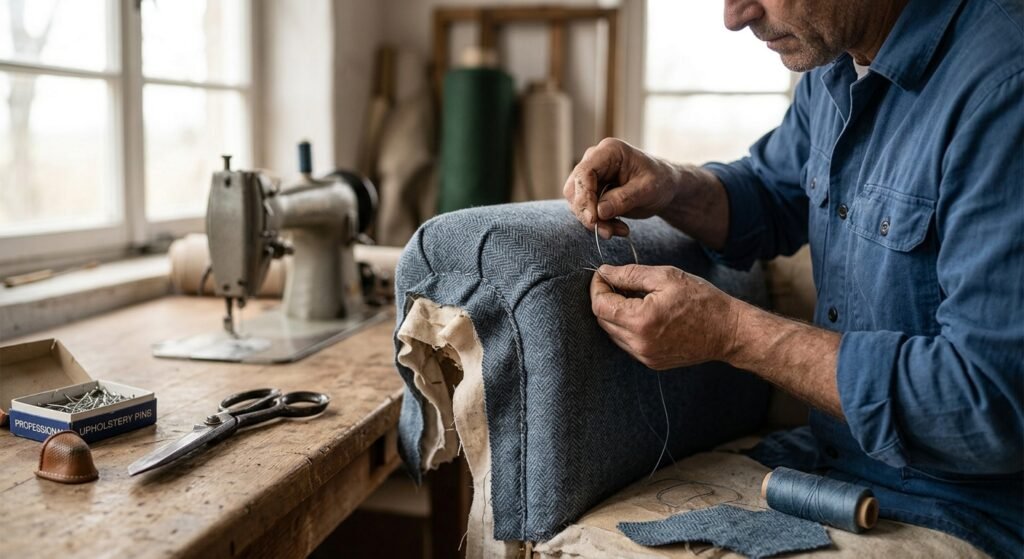
Piping is made up and stitched into the seams, cushions are cut and closed, and any buttoning, trims, or stud-work is applied at this stage. Deep buttoning in particular is time consuming, hand-worked, and difficult to correct once the fabric is under tension. The fabric itself can impact lead time. Stock lines can often be delivered within days, while fabrics woven to order or shipped from overseas take considerably longer, and this is frequently the single largest variable in the overall lead time.
Why Prices Vary Between Pieces and Between Workshops
Quotes for the same piece of furniture can vary between workshops by roughly 18 percent either way, and comparing prices is sensible. A wide variation usually reflects a different reading of the work required rather than a different hourly rate, which is why it is worth asking what a quotation assumes about the frame, the suspension, and the fillings, rather than comparing headline figures alone.
Capacity is the other factor behind both price and lead time. Heritage Crafts records upholstery and soft furnishings as a currently viable craft, but identifies skill shortages caused by a lack of training and apprenticeships over the past 25 years. Training routes exist, including the AMUSF diploma and a two-year T-Level in craft and design upholstery with a 90-day industry placement, but the number of qualified upholsterers entering the trade remains limited. Workshops are constrained by the people in them, which is why a queue is normal rather than a sign of poor organisation.
How We Handle the Process at Fineline Upholstery
We begin with an assessment of the piece rather than a price. Photographs and rough dimensions are usually enough in most instances; for larger commercial or more unusual pieces we make an appointment to conduct a site assessment which is subject to a consultation fee. We look to establish the condition as far as it can be judged with the cover on, and what the client’s requirements are from the finished article.
We provide transparency regarding what a quotation can and cannot cover. The visible work can be priced with reasonable confidence. The frame, springs, and fillings cannot be fully assessed until the piece is stripped. If we find something at that stage that changes the work involved, we stop, explain what we have found, and agree the position with the client before continuing. We would rather have that conversation mid-project than present an unexpected additional fee at the end.
We provide honest recommendations in instances where a frame does not justify the cost of bespoke upholstery and often recommend when a potential client might be better off purchasing new furniture instead of going down the route of reupholstery. Reupholstering a failing particleboard frame will require significant repair and strengthening processes to produce a level of work that we would deem acceptable, but at the same time cannot fully guarantee longevity under extreme conditions of usage. Where the frame is sound hardwood, the opposite applies, and the piece can reasonably be expected to give many years of further use once rebuilt.
On project duration, we base our discussions with clients on the lead time rather than the bench time as the lead time is the period for which a client will be without their piece. Fabric is usually the most dynamic variable, so we confirm stock availability before committing to project dates. The choice of fabric remains the client’s; our role is to explain how each option performs, what it will do to the timescale, and whether it suits the piece and its use. We hold sample books so that selections can be made from the material itself, we also have the facility to order any samples that clients find online for our extensive list of suppliers.
We do not rush the stages that need time. Adhesive bonds at its own rate, stitched edges require careful and patient precision, and buttoning cannot be hurried without the inaccuracies being evident in the finished work. A piece that is rushed through the workshop tends to come back which benefits neither our clients nor us.
If you are considering reupholstery, send us photographs of your furniture along with dimensions and let us know how it is used and what you would like changed. We can set out what the work would entail, what it would cost, and provide a realistic time-frame before any commitments or obligations are made.”
Our Services
Headboards/ Bedframes
Bespoke Loose Covers
Commercial Upholstery
Curtains & Blinds
Bespoke Upholstery
Bespoke Cushions
EXCELLENTTrustindex verifies that the original source of the review is Google. Fineupholstery are wonderful. I have used their services before. I took in an old and very interesting chair for them to re-cover. It was quite complicated and they have done an excellent job. I am thrilled with the new look. And they were so helpful with fabric choice. I felt looked after and will happily to continue using their expert recovering services again. Thank you to all.Posted on GoogleTrustindex verifies that the original source of the review is Google. I contacted Fineline Upholstery to ask for some help with a damaged sofa. They were very prompt, asked for all the necessary details in one email so that once that was provided they could provide a quote and then come and carry out the work. It was effortless and I am very happy with their speed and professionalism. I would definitely use them again.Posted on GoogleTrustindex verifies that the original source of the review is Google. Excellent service and beautifully reupholstered armchair. Top job from beginning to end. Thank you!Posted on GoogleTrustindex verifies that the original source of the review is Google. Friendly, reliable and excellent craftsmanship! Thanks v much :) love our “new” furniturePosted on GoogleTrustindex verifies that the original source of the review is Google. It’s not just the quality of the upholstery, which is absolutely outstanding, but also the excellent customer service. All done really efficiently with updates at every stage.Posted on GoogleTrustindex verifies that the original source of the review is Google. It was a pleasure dealing with Fineline Upholsterers. Their work is of the highest standard and we were delighted with their speedy, prompt and excellent service. I would highly recommend them.Posted on GoogleTrustindex verifies that the original source of the review is Google. I dumped a whole pile of unsatisfactory sofa seat cushions in the workshop. 2 weeks later they were delivered home all pristine and plumped. So easy. So efficient. I can’t wait for my next project!Posted on GoogleTrustindex verifies that the original source of the review is Google. Highly recommended! Fineline Upholstery could not have done more to help. We had a bed that unfortunately got damaged during a house move. Collection, return and reassembly were all carried out efficiently and professionally. The quality of the reupholstered bed could not have been better. We will certainly use again.Posted on GoogleTrustindex verifies that the original source of the review is Google. Excellent service courteous and extremely efficient. Thank you Min. Delighted with the cushions beautifully made and ready much earlier than expected. Thank you Chris.Posted on GoogleTrustindex verifies that the original source of the review is Google. Can’t recommend this company highly enough! Have now used them twice: re-padding and re-upholstery of antique dining chairs and re-upholstery of new chaise. The results were brilliant, excellently made and the customer service responsive, attentive and very efficient. Prices are fair and reasonable. Thankyou!


Our Location
Address: 63 New King’s Road, Fulham, London, SW6 4SE
Opening time:
Monday – Friday: 9:00am – 5:00pm
Saturday: 9:00am – 4:00pm
Sunday: Closed
Speak with the Team
020 7371 7073
info@finelineupholstery.co.uk
