Fineline Upholstery
Fineline Upholstery
Springs, Webbing, and Padding: What Gives Quality Seating Its Comfort
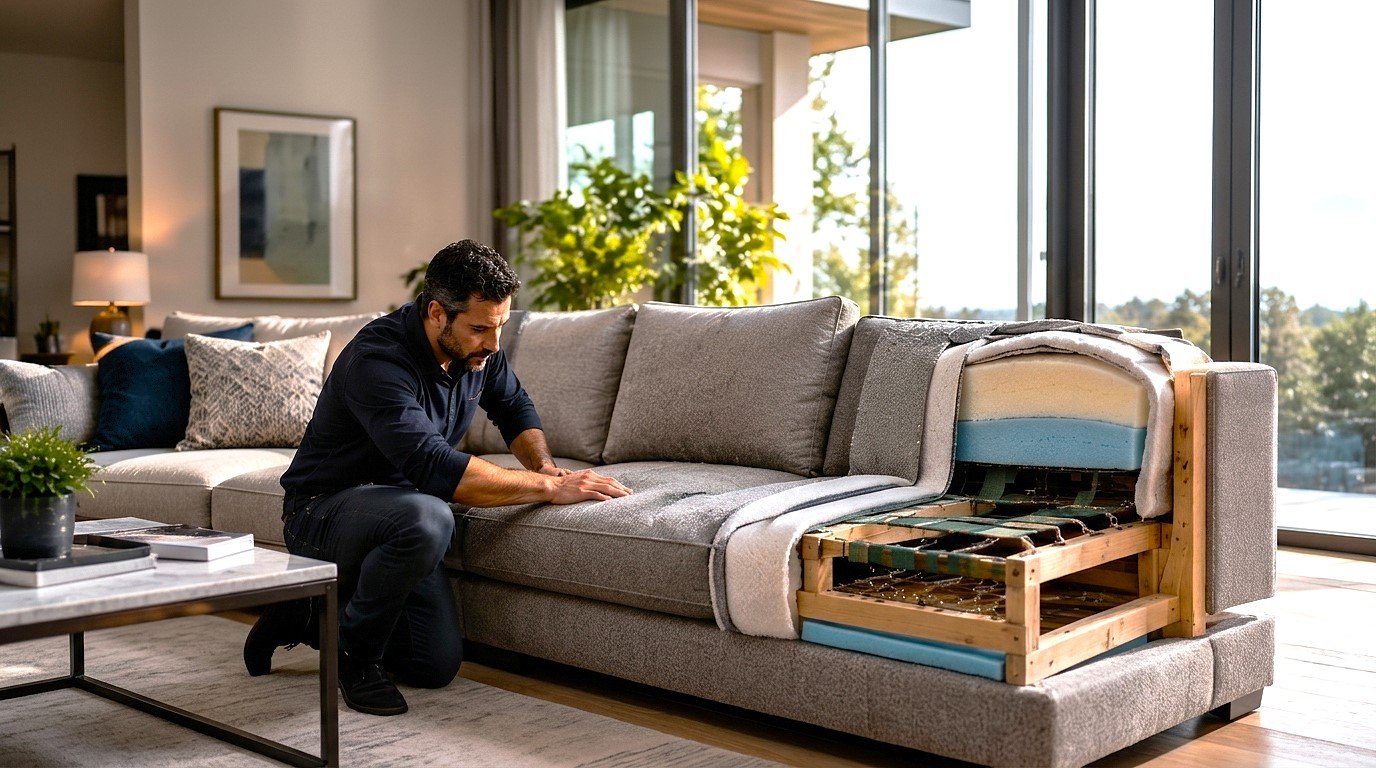
Furniture is chosen by appearance and judged by comfort. In a showroom, the outer aesthetic gets all the attention and is generally the primary focus. Comfort, however, is created almost entirely by what you never see: the suspension construction and layers of padding built on top of it. These determine how a seat feels on the first day and, more importantly, how it feels in its fifth year.
When furniture sags, flattens, develops a hollow, or permanently dents where somebody regularly sits, the fabric isn’t to blame. The failure occurs deeper down in the unseen construction and craft that determine how long seating will actually survive. This article explains what the internal components do, how the main types differ in working life, and why the difference between well-made seating and inexpensive mass-market furniture is largely invisible at the point of purchase.
Three Layers, Three Separate Jobs
For the purpose of simple explanation, upholstered seating can be described as being made up of three layers, each carrying a distinct responsibility. The suspension, which in the majority of cases is either a type of webbing or a network of springs, is positioned and tensioned across the entire frame of a piece. This section carries the load and distributes weight across the whole seat evenly rather than concentrating the pressure of use to a single point. The padding, which will generally be foam or natural fibres, determines the feel of the surface and creates the silhouette of the piece. The fabric protects and conceals both sub-layers and determines appearance.
With each of these layers playing its own specific part in any piece of furniture, they each have different reasons for failure. A suspension layer that has lost tension will produce a seat that feels as though the user is sinking too deeply into the frame, often with an audible indication when weight is applied. Padding that has broken down produces a seat that may appear level, but that feels thin and hard, with permanent hollows where the piece is used most. The two conditions require different remedies and carry different costs, which is why a proper assessment identifies which layer requires attention before any work is quoted.
Sagging and flattening are not the same fault. Sagging generally indicates a suspension problem; flattening generally indicates a filling problem. A seat can be re-padded while the suspension beneath it is still failing, which produces a piece that feels corrected for a short period and then returns to the original condition.
Webbing: The Simplest Form of Support
Webbing is the oldest and most economical form of suspension. Strips of material are stretched under tension across the frame and interwoven to form a platform. In Traditional upholstery, jute webbing is used in sprung seats as a network to connect the base springs to each other; in unsprung seats, jute webbing can be used as the support itself. Elasticated and rubber webbings, of which Pirelli is the best known, were developed for the lower, flatter seat profiles of mid-century and contemporary furniture.
The integrity and longevity of any piece will vary considerably with the quality and quantity of the components and materials used. One trade assessment gives generic webbing a working life of around five to seven years, against roughly 50,000 compression cycles to failure. A specialist furniture writer draws a sharper distinction, noting that cheaper stretchable webbing can break or sag within a few years, while high-quality non-stretch webbing installed correctly should last twenty years and more.
The same writer identifies a point worth noting when assessing inexpensive furniture: lower-quality manufacturers tend to use less webbing, with fewer strands used to make up the suspension network, which creates wider gaps in the suspension layer. Webbing that is too widely spaced frays at the edges and eventually breaks; as a result, the seat will begin to sag long before the outer fabric shows any wear.
A quotation given at this stage is based on what can be seen. This type of assessment covers most of the work, but it is an assessment rather than a certainty. Frames, springs, and old repairs are concealed by the existing upholstery, and their condition can only be confirmed once the piece is stripped. Most workshops handle this by quoting for the expected work and agreeing to discuss anything unexpected before proceeding, rather than by building a contingency into every price.
Springs: Where the Working Life Is Longest
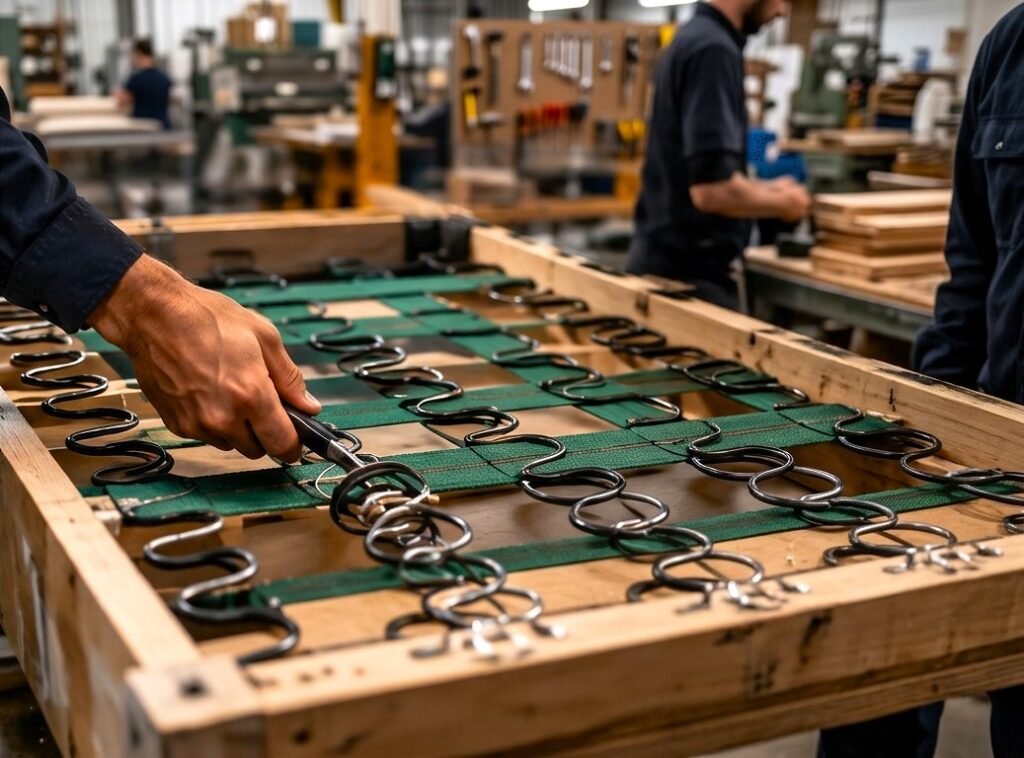
Springs carry out what webbing alone cannot, they compress progressively under load and recover afterwards. Two systems are commonly encountered.
Coil springs, hand-tied: Individual coils are fixed to the webbing base, tied to one another and secured to the frame so that the seat compresses as a single unit rather than as a set of separate points. The system distributes weight evenly and recovers its shape after use. Published trade benchmarks put the working life at twenty years or more, against figures in excess of 200,000 compression cycles. The labour involved is substantial, which is the reason the system is largely absent from mass-produced furniture.
Serpentine or sinuous springs: Pre-formed S-shaped wires run across the frame and are secured at each end. The system is considerably quicker to install and costs less. The same benchmarks give a working life of roughly ten to fifteen years and around 100,000 cycles, with wire gauge as the determining factor. Eight-gauge wire is regarded as the durable specification, nine-gauge as marginal, and eleven-gauge as prone to giving way. Lower gauge numbers indicate thicker wire, so a manufacturer economising on this component will not be visible to a buyer.
These figures are published as relative benchmarks rather than guarantees, as stated by the source. They are useful for comparing systems against one another but should not be considered as a warranty of years. Actual working life depends on the weight the seat carries, how often it is used, and whether the frame holding the suspension is itself sound.
It is also important to note that hand-tied coils are not automatically the correct answer for every piece. The same trade writer notes that beneath a thick, high-resilience cushion, an elasticated webbing platform and a sinuous spring platform will not feel significantly different from a far more expensive hand-tied unit, and that the twine in hand-tied work can perish after about twenty years. The appropriate system is determined by how the piece was originally constructed and how it will be used.
Padding: Where Comfort Is Actually Felt
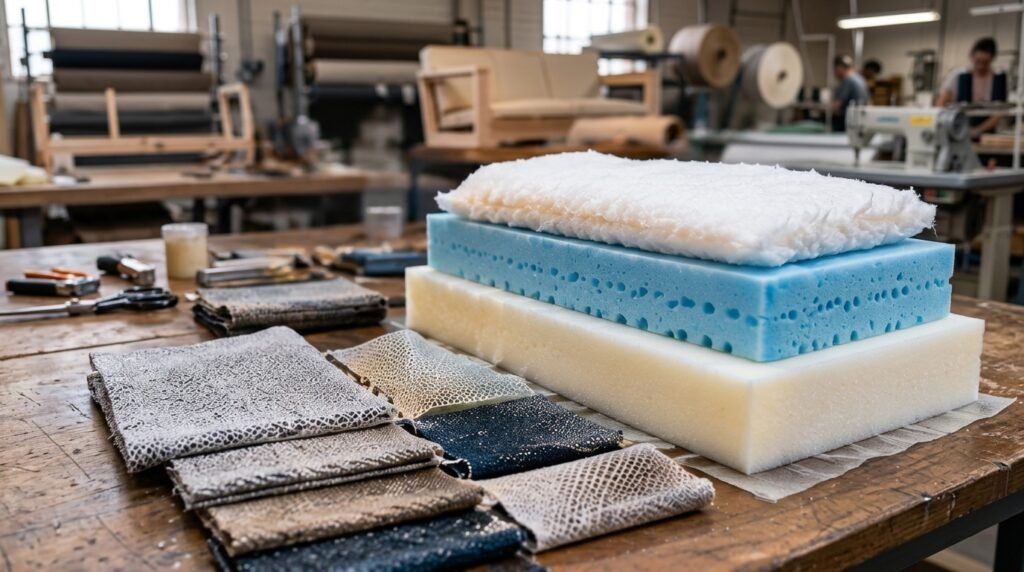
The suspension carries the load, but the padding is the layer a person makes contact with. In modern furniture this generally means polyurethane foam, specified by density in kilogrammes per cubic metre. Density describes the mass of material in the foam rather than its firmness, and it is the figure most closely associated with how long a cushion holds its shape.
Published guidance from the furniture trade sets out a consistent progression. Foam in the region of 18 to 22 kg/m³, used widely in budget furniture, can collapse within two to three years. Foam of 25 to 28 kg/m³ is described as acceptable for occasional use, losing around 30 to 40 percent of its support within five to six years of regular use. Foam at approximately 30 kg/m³ is given an eight to ten year working life in domestic use, and high-resilience foam at around 35 kg/m³ is presented as the benchmark for quality furniture at fifteen to twenty years. Contract and commercial specifications generally begin at 40 kg/m³.
Foam density is rarely disclosed at the point of sale. When a retailer cannot state the density of the foam in a cushion, that absence is itself informative, because the figure is known to the manufacturer and is only withheld when it is unremarkable.
Traditional fillings behave differently. Ginger / Coir fibre and curled horsehair, used in traditional work beneath stitched edges, do not collapse in the way that low-density foam does. They compact gradually and can often be supplemented and reused rather than replaced outright. They are labour-intensive to work with and are generally found in older pieces and in restoration rather than in current mass production.
What the Testing Standards Do and Do Not Cover
Domestic seating sold in the UK is assessed against BS EN 12520, revised in 2024 and adopted across CEN member states by May 2025. The standard sets requirements for safety, strength, and durability, including static load testing of arm rests, which the revision raised from 700N to 750N, and seat impact testing carried out as a series of drops. Non-domestic seating falls under BS EN 16139, and contract seating performance requirements are commonly specified for persons weighing up to 200kg.
These standards establish that a piece of furniture is safe and structurally sound. They do not establish that a seat will remain comfortable for fifteen years. A sofa can satisfy the relevant standard and still be built with low-density foam on widely spaced webbing, because the standard measures strength and stability rather than the rate at which support degrades under daily domestic use. Compliance is a floor rather than a measure of quality.
Why Inexpensive Furniture Fails Early
Manufacturing cost is concentrated in the components a buyer cannot inspect. A thinner gauge of spring wire, fewer strands of webbing, and foam with two density grades lower will reduce the cost of a sofa substantially while changing nothing a customer can see in a showroom. The piece feels acceptable when new because new foam of almost any density feels supportive. The difference appears between the second and fifth year.
Industry commentary places the point at which most mass-market sofas begin to sag at three to five years. Consumer research gives a similar picture: around 25 percent of UK adults replace a piece of furniture at least once a year, and fewer than one in ten consider repairing furniture to extend its life. The consequence is visible in waste figures, with approximately 22 million pieces of furniture discarded annually in the UK, amounting to around 670,000 tonnes.
The distinction that matters for anyone deciding between replacement and reupholstery is whether the frame and the suspension can withstand reupholstery. A sound hardwood frame with a repairable suspension justifies rebuilding, because the expensive, labour-intensive structure is already there. A stapled particleboard frame with collapsed foam on minimal webbing is a highly unsuitable candidate for the work, since there is nothing sound to build onto and the cost of the labour will not be financially feasible.

How We Approach Internal Support at Fineline Upholstery
We begin by establishing which layers have failed. A client describing a sofa as uncomfortable may be describing a slack suspension, broken-down padding, or both, and the remedies differ in scope and in cost. Sitting on the piece and examining it from beneath usually settles the question quickly.
Where the suspension has failed, we rebuild it in the system the piece was constructed for. A frame designed for coil springs is rebuilt with coil springs, and a frame designed for a webbing platform is re-webbed. Fitting a cheaper system into a frame built for a traditional one changes the way the seat sits and the depth of the finished piece, and the saving is rarely worth the result.
On padding, we discuss the intended use before specifying a density. Seating in daily family use is specified differently from an occasional chair in a formal room, and the heaviest available specification is not automatically the correct one. We can provide clarity regarding what each grade will deliver over time, including the point at which it can be expected to soften.
We hold samples of foam grades and can show the difference in the materials themselves. Density is difficult to judge from a description and simple to judge by handling two pieces side by side. Where a client prefers the feel of traditional fillings, we explain the maintenance those materials require and the additional labour involved, so that the choice is made from a position of client understanding.
Where the underlying structure does not justify the work, we say so at the assessment stage. Rebuilding the interior of a piece whose frame is already failing produces a sofa that performs acceptably for a short period and then fails again.
If a seat in your home has begun to sag, flatten, or sit lower on one side, send us photographs of the piece, including the underside if it can be reached, and let us know how often it is used. We can identify which layer has failed, explain what rebuilding would involve, and set out whether the piece justifies the work before any commitment is made.
Our Services
Headboards/ Bedframes
Bespoke Loose Covers
Commercial Upholstery
Curtains & Blinds
Bespoke Upholstery
Bespoke Cushions
EXCELLENTTrustindex verifies that the original source of the review is Google. Fineupholstery are wonderful. I have used their services before. I took in an old and very interesting chair for them to re-cover. It was quite complicated and they have done an excellent job. I am thrilled with the new look. And they were so helpful with fabric choice. I felt looked after and will happily to continue using their expert recovering services again. Thank you to all.Posted on GoogleTrustindex verifies that the original source of the review is Google. I contacted Fineline Upholstery to ask for some help with a damaged sofa. They were very prompt, asked for all the necessary details in one email so that once that was provided they could provide a quote and then come and carry out the work. It was effortless and I am very happy with their speed and professionalism. I would definitely use them again.Posted on GoogleTrustindex verifies that the original source of the review is Google. Excellent service and beautifully reupholstered armchair. Top job from beginning to end. Thank you!Posted on GoogleTrustindex verifies that the original source of the review is Google. Friendly, reliable and excellent craftsmanship! Thanks v much :) love our “new” furniturePosted on GoogleTrustindex verifies that the original source of the review is Google. It’s not just the quality of the upholstery, which is absolutely outstanding, but also the excellent customer service. All done really efficiently with updates at every stage.Posted on GoogleTrustindex verifies that the original source of the review is Google. It was a pleasure dealing with Fineline Upholsterers. Their work is of the highest standard and we were delighted with their speedy, prompt and excellent service. I would highly recommend them.Posted on GoogleTrustindex verifies that the original source of the review is Google. I dumped a whole pile of unsatisfactory sofa seat cushions in the workshop. 2 weeks later they were delivered home all pristine and plumped. So easy. So efficient. I can’t wait for my next project!Posted on GoogleTrustindex verifies that the original source of the review is Google. Highly recommended! Fineline Upholstery could not have done more to help. We had a bed that unfortunately got damaged during a house move. Collection, return and reassembly were all carried out efficiently and professionally. The quality of the reupholstered bed could not have been better. We will certainly use again.Posted on GoogleTrustindex verifies that the original source of the review is Google. Excellent service courteous and extremely efficient. Thank you Min. Delighted with the cushions beautifully made and ready much earlier than expected. Thank you Chris.Posted on GoogleTrustindex verifies that the original source of the review is Google. Can’t recommend this company highly enough! Have now used them twice: re-padding and re-upholstery of antique dining chairs and re-upholstery of new chaise. The results were brilliant, excellently made and the customer service responsive, attentive and very efficient. Prices are fair and reasonable. Thankyou!



Our Location
Address: 63 New King’s Road, Fulham, London, SW6 4SE
Opening time:
Monday – Friday: 9:00am – 5:00pm
Saturday: 9:00am – 4:00pm
Sunday: Closed
Speak with the Team
020 7371 7073
info@finelineupholstery.co.uk
