Fineline Upholstery
Fineline Upholstery
Real Leather vs. Faux Leather: Durability, Cost, and Long-Term Value
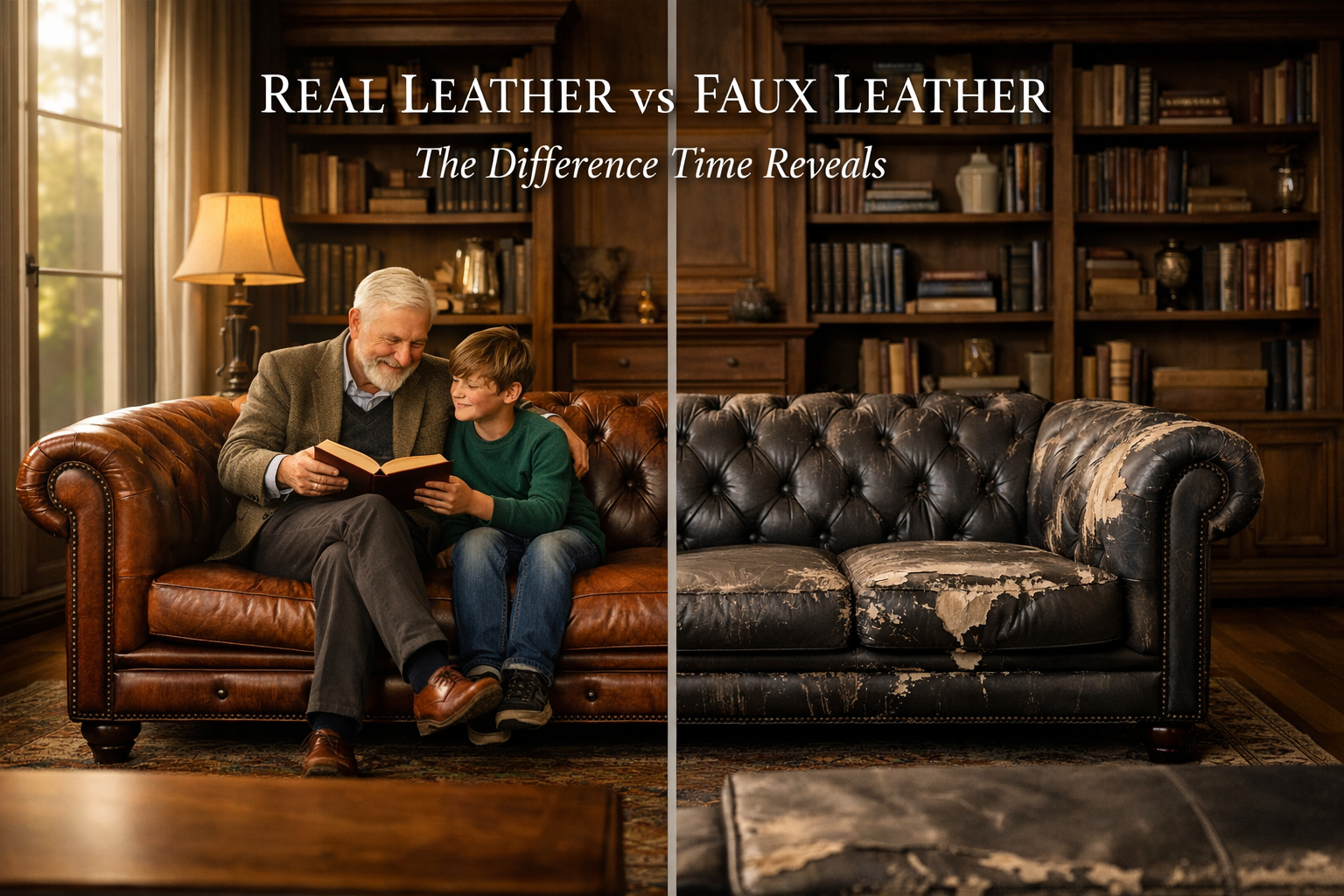
The choice between real leather and faux leather represents a practical decision with measurable effects. While both materials serve similar functions and can appear similar initially, they differ substantially in durability, maintenance requirements, long-term cost, and how they perform and age over years of use. Understanding these differences exemplifies why specific applications benefit from informed and considered material choices.
This article examines the variations between real leather and faux leather through data on lifespan, cost per year of use, maintenance requirements, and actual performance patterns. The focus is on practical function rather than preference, establishing what each material can realistically be expected to deliver.
Material Composition and Types
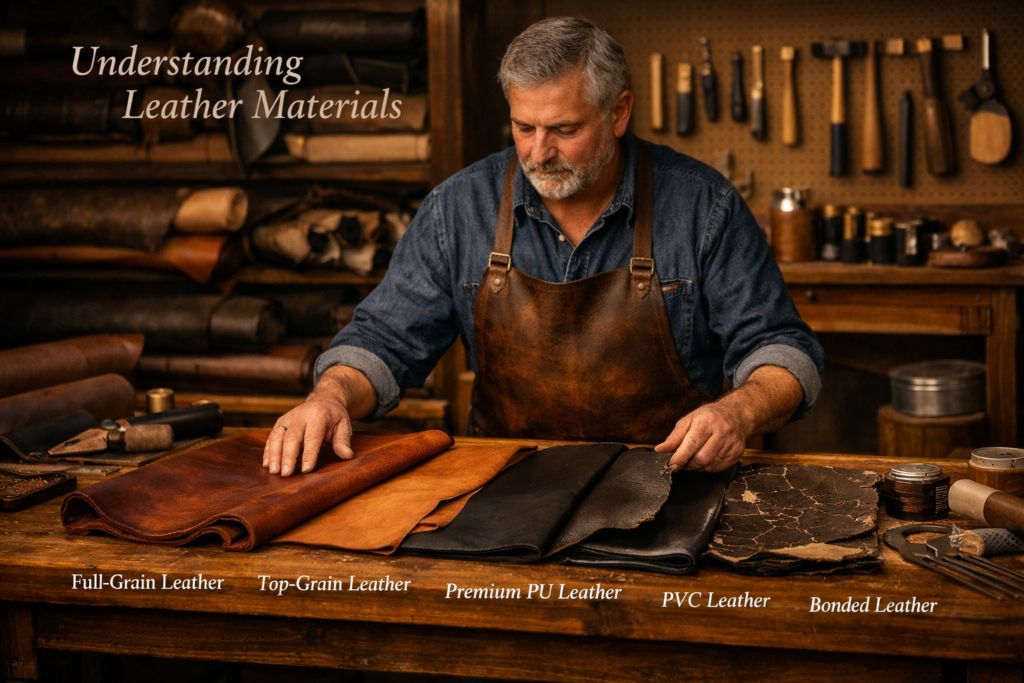
One of the fundamental differences centres around material origin and composition. Real leather comes from tanned animal hide, most commonly cowhide, processed to create a flexible, durable textile. Faux leather, also called synthetic or vegan leather, is manufactured from synthetic polymers, typically polyurethane (PU) or polyvinyl chloride (PVC), applied as a coating to a fabric backing.
Real leather grades: Full-grain leather is the highest quality, retaining the natural surface with all imperfections intact. Top-grain leather removes the surface layer, creating a more uniform appearance while retaining durability. Genuine leather indicates lower grades with more processing. Each grade performs differently in durability and aesthetic aging.
Faux leather types: Polyurethane (PU) leather uses fabric backing coated with polyurethane, offering better breathability and flexibility than PVC alternatives. Polyvinyl chloride (PVC) leather is more water-resistant and durable but less breathable and stiffer. Ultra leather represents a premium synthetic option offering enhanced durability. Bonded leather, consisting of 10-20 percent genuine leather scraps mixed with polyurethane binder, represents the lowest quality option and should be avoided entirely.
Lifespan: Measurable Differences in Durability
The distinction between real and faux leather becomes most apparent when examining actual lifespan data based on typical use conditions.
Real leather lifespan: Quality real leather consistently lasts 15 to 25 years or longer with proper care. Well-maintained full-grain leather can function for 20 to 50 years. A leather sofa constructed from quality materials and properly conditioned and maintained can become a family heirloom used across multiple generations. The material actually improves with age, developing a protective patina that adds character while maintaining structural integrity.
Faux leather lifespan: Standard faux leather furniture typically lasts 2 to 5 years with regular use. High-quality PU leather may extend to 5 to 7 years under optimal conditions. Premium options like Ultra leather can reach 10 to 15 years with proper care. However, most PU leather will experience some form of peeling, cracking, or flaking beginning around the 2 to 4 year mark, particularly at stress points such as cushion seams, armrests, and areas subject to friction.
Bonded leather: This material is the least durable option available. Bonded leather typically lasts only 1 to 3 years before visible peeling and deterioration begin. Once degradation starts, it accelerates and cannot be stopped or reversed. Industry analysis consistently recommends avoiding bonded leather entirely due to poor lifespan and inability to be repaired.
Cost per Year of Use: Long-Term Value Analysis
The initial purchase price difference often obscures actual long-term cost when replacement frequency and lifespan are factored into calculations.
Example calculation: A quality leather sofa costing £2,000 and lasting 20 years averages £100 per year of use. A faux leather sofa costing £600 and lasting 3 years averages £200 per year of use. Despite the higher initial investment, the leather sofa costs significantly less per year of actual use. This calculation demonstrates that apparent savings from initial purchase price often represent poor long-term value.
Additional costs associated with faux leather include replacement labour, delivery, and disposal of the degraded item. Each replacement cycle incurs these costs in addition to a new furniture purchase. Over a 20-year period, a household may need to replace faux leather furniture 4 to 6 times, while real leather requires replacement perhaps once, if at all.
Real leather requires conditioning and maintenance; this can be done using typically inexpensive leather care products applied every 3 to 6 months. This maintenance investment, approximately £100 to £300 over 20 years, extends leather lifespan substantially. Faux leather requires only occasional wiping with a damp cloth, avoiding this maintenance cost but providing no extension of lifespan.
How Faux Leather Fails: The Mechanics of Degradation
Understanding how faux leather deteriorates clarifies why lifespan differences exist. Faux leather fails through a specific chemical process that cannot be stopped once initiated.
Hydrolysis breakdown: Faux leather degrades through hydrolysis, a chemical reaction between the polyurethane or PVC plastic coating and moisture in the air. This reaction causes the plastic layer to separate from the fabric backing underneath. Peeling typically begins at stress points: armrest creases, seam locations, areas subject to repeated contact, then spreads across the surface. Once this separation begins, typically within 2 to 5 years, the damage is irreversible. No repair method can re-bond the separated layers.
Contrast with real leather aging: Real leather degrades through drying, which means loss of natural oils that maintain fibre flexibility. This process is entirely reversible through conditioning, also known as ‘leather feeding’. Conditioning restores moisture and suppleness, preventing cracking and extending lifespan indefinitely. A dried leather sofa conditioned properly will return to functional use provided that the drying has not caused significant degradation resulting in cracking and tearing. A peeling faux leather sofa cannot be similarly restored.
This fundamental difference in degradation mechanisms explains why real leather can be maintained and repaired throughout its life while faux leather, once peeling begins, can only be discarded and replaced.
Maintenance Requirements and Practical Performance
The maintenance needs of real and faux leather differ substantially, affecting both cost and convenience of ownership.
Real leather maintenance: Quality leather requires conditioning every 3 to 6 months using leather conditioner containing lanolin, beeswax, or neat’s-foot oil. This maintenance takes approximately 10 minutes per application, or about 40 minutes per year invested to extend lifespan by decades. Regular cleaning with appropriate leather cleaners maintains appearance. Professional repair services can address significant damage including torn seams, large scratches, or fading. Minor scratches often buff out with conditioner. Proper maintenance is the trade-off for dramatically extended lifespan.
Faux leather maintenance: Faux leather requires minimal maintenance; occasional wiping with a damp cloth addresses mild stains and dust. No conditioning is necessary. This convenience comes with a fixed cost: once peeling begins, no maintenance can prevent or repair the degradation. The low maintenance requirement does not extend lifespan; it only reduces upkeep labour until replacement becomes necessary.
Breathability also differs measurably. Real leather’s natural porous structure allows air circulation and moisture wicking, meaning leather adjusts to body temperature rather than trapping heat. Faux leather, particularly PVC-based products, traps heat and moisture, which can feel uncomfortable during extended use or warm weather. PU leather offers better breathability than PVC but still cannot match natural leather’s ventilation properties.
Patina and Aging: Aesthetic Development
The nature of how, and extent to which, materials change over time affects long-term satisfaction with furniture. Real leather and faux leather follow opposite aging patterns.
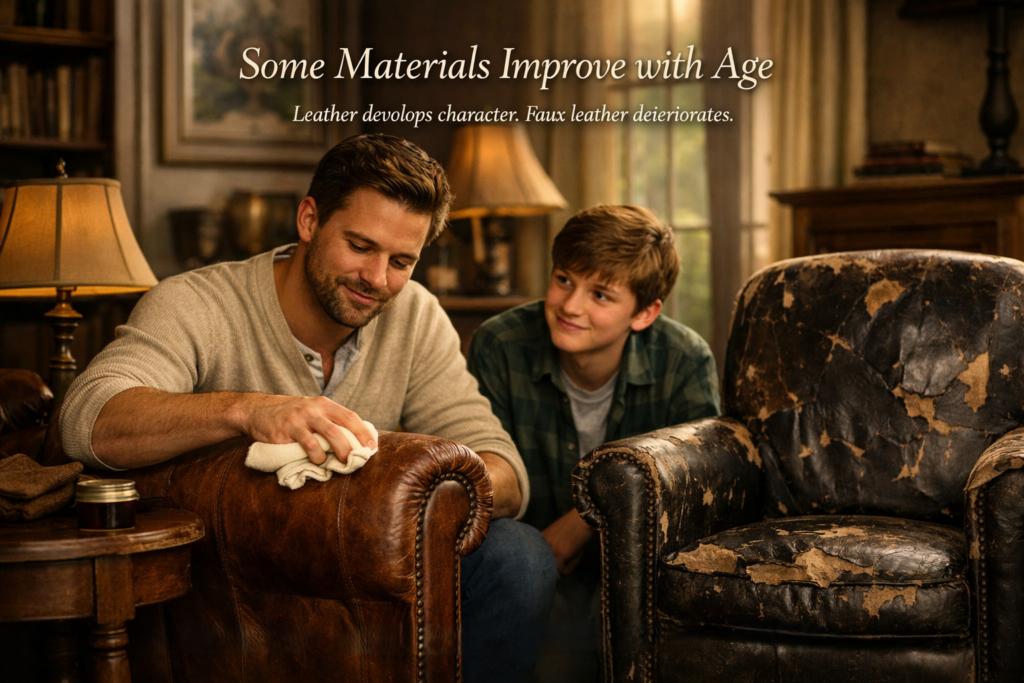
Real leather patina: Quality leather develops a unique patina, a soft sheen created by natural oils and use patterns. This patina develops character over years, becoming richer and more attractive with age. The colour deepens. The surface becomes suppler. Minor scratches often blend into the patina rather than appearing as defects. This aging process is universally valued by leather enthusiasts because it documents the object’s history and use.
Faux leather deterioration: Faux leather does not age attractively. Surface wear shows as visible degradation: cracking, peeling, fading, scratches that do not blend with surrounding areas. Unlike real leather’s desirable patina, faux leather’s aging is purely destructive, showing wear that detracts from appearance. This visible deterioration is why faux leather furniture looks noticeably aged within 3 to 5 years, whereas leather furniture of similar age often appears more attractive than new.
Potential for Repair and Recovery from Damage
The ability to repair and restore materials significantly affects their practical value over time.
Real leather repair: Real leather is repairable at every stage of its life. Surface scratches are buffed out with conditioner. Wrinkles and creases respond to steam and conditioning. Faded colour can be restored through professional re-dyeing. Torn seams are re-stitched by leather specialists. Significant structural damage is often repairable. This repairability means a damaged leather sofa can be professionally restored to usable condition, extending its functional life further. While repair can be carried out at any stage of damage, it is important to note that there is a point at which seam damage or significant tearing would require the introduction of new patches or sections of leather. The newly introduced leather will not always be the same shade or carry the same pattern of wear, but over time and with use can blend in, creating a seamless appearance.
Faux leather repair: Faux leather offers little to no repair options once degradation begins. Peeling cannot be reversed. Cracks cannot be sealed permanently. Once the plastic coating separates from the backing, no technique exists to re-bond the layers. The furniture piece will become unusable and must be discarded and replaced.
The difference between reversible aging (real leather) and irreversible degradation (faux leather) fundamentally affects long-term value. Leather can be maintained indefinitely; faux leather has a fixed expiration date.
Environmental Considerations
The environmental impact of real and faux leather differs in ways often misunderstood by consumers.
Real leather: Leather is biodegradable, decomposing within 10 to 50 years when discarded. However, the tanning processes used to create leather involve chemicals that can cause environmental damage through runoff and processing waste. The production requires water, energy, and chemical inputs. Environmental impact exists but is finite; the material eventually returns to earth.
Faux leather: Most faux leather is petroleum-based, made from non-renewable crude oil. It is not biodegradable and contributes to landfill waste indefinitely. Manufacturing produces significant chemical waste and pollution. The frequent replacement requirement- faux leather lasting 2 to 5 years versus leather lasting 15 to 25 years, means more total material is produced and discarded over a given timespan. Emerging plant-based leather alternatives using mushroom, pineapple, cactus, or apple peels offer more sustainable synthetic options, but traditional PU and PVC remain the market standard.
From a purely environmental standpoint, leather’s longer lifespan means fewer total furniture pieces are required over time, reducing overall production impact despite the chemical costs of tanning.
How We Approach Material Selection at Fineline Upholstery
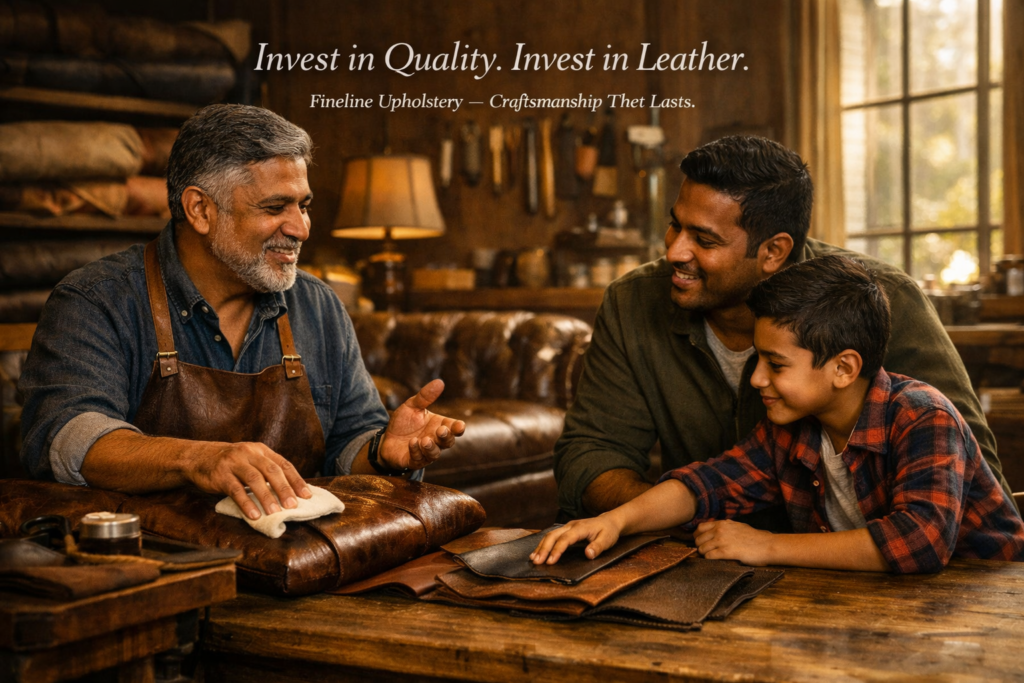
Clients selecting upholstery materials often balance initial cost, aesthetic preference, and practical performance requirements. Our approach begins with understanding how the furniture will actually be used.
For primary furniture used daily for years, we typically recommend real leather. The superior durability, repairability, and developing character justify the higher initial investment when cost per year of use is calculated. A family living room sofa or primary office chair benefits substantially from leather’s long lifespan. The furniture becomes more attractive with age rather than noticeably deteriorating within 3 to 5 years.
For secondary seating used occasionally or in specific applications, faux leather can make sense. Guest room furniture, decorative pieces used infrequently, or situations where animal product concerns override durability priorities can benefit from faux leather’s lower cost and simpler maintenance. However, we always discuss the realistic 2 to 5 year lifespan so clients understand that replacement is planned, not unexpected.
We specifically avoid recommending bonded leather. The poor durability, inability to be repaired, and frequent replacement requirements make it an unwise choice regardless of initial cost savings. The apparent bargain becomes expensive when the furniture must be replaced within 1 to 3 years.
When clients select leather, we recommend quality grades from trusted tanneries; full-grain or top-grain leather rather than lower grades. The additional initial cost is recovered through extended lifespan and superior performance. We also discuss conditioning requirements honestly, explaining that approximately 10 minutes every 3 to 6 months of conditioning maintenance dramatically extends lifespan.
For faux leather selections, we are direct about limitations. We explain that peeling will likely begin within 3 to 5 years, that the damage cannot be repaired, and that replacement will be necessary. Honest expectations prevent disappointment when the expected degradation occurs. We also help clients understand whether premium options like Ultra-leather might extend lifespan to 10 to 15 years, which can represent better value than standard faux leather.
We hold samples of both materials so clients can assess texture, appearance, and feel before decisions are made. Touching real and faux leather side by side, and understanding how each will likely perform and age, helps clients make choices aligned with their actual priorities and realistic expectations.
If you are planning upholstery work and unsure whether real leather or faux leather is appropriate for your situation, send us photographs of your space and furniture and let us know how the furniture will be used. We can discuss which material aligns with your timeline, budget, maintenance preferences, and actual long-term value requirements. The choice is not universal; it depends on what the furniture is and what you expect it to deliver.
Our Services
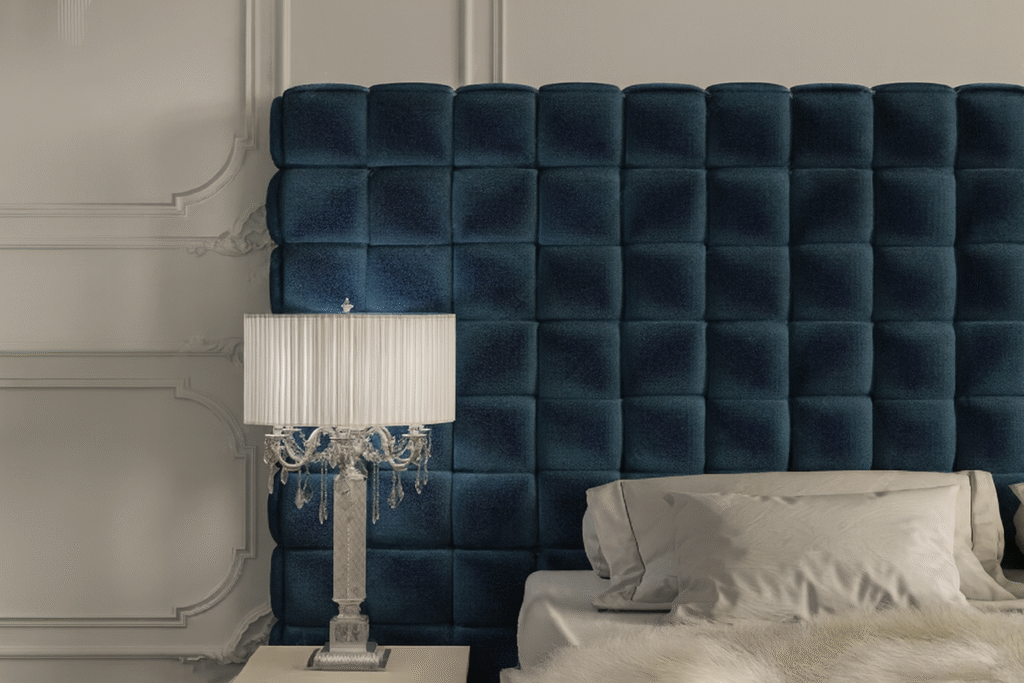
Headboards/ Bedframes
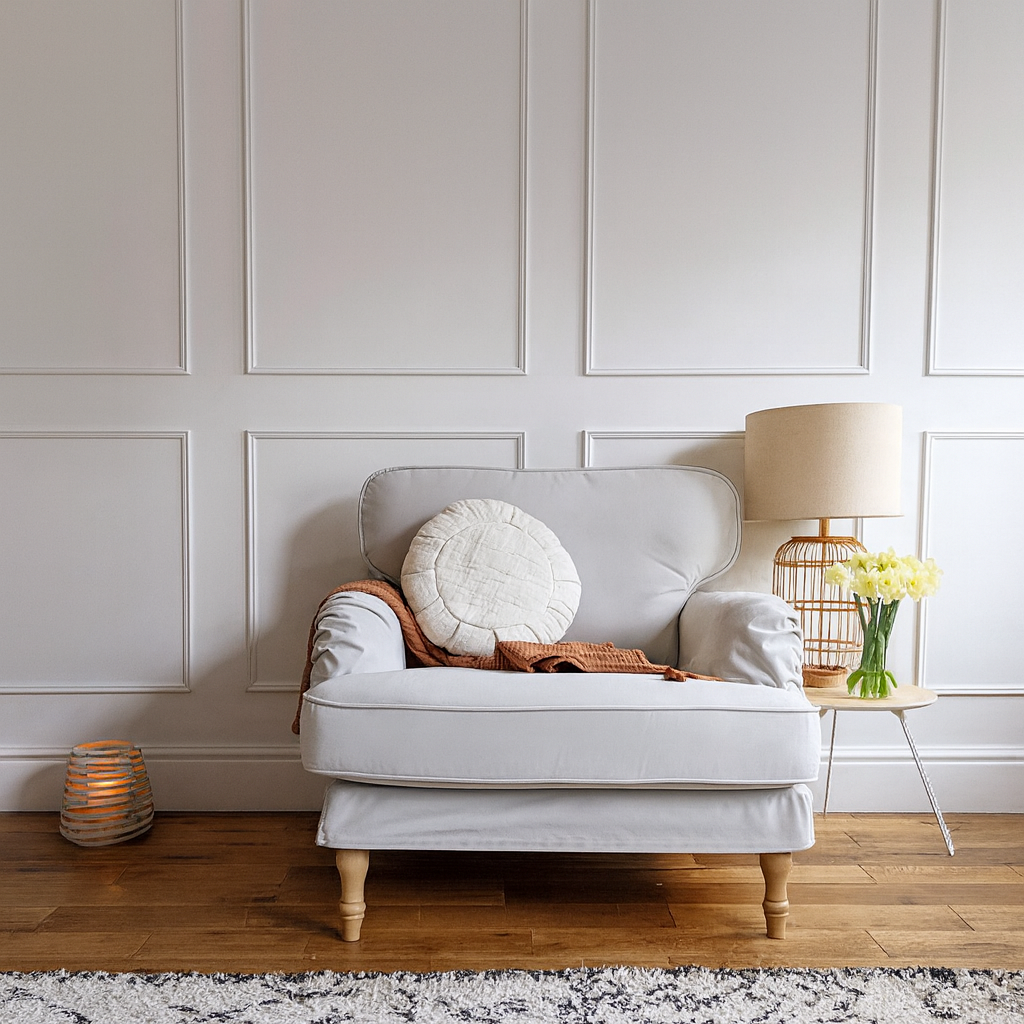
Bespoke Loose Covers
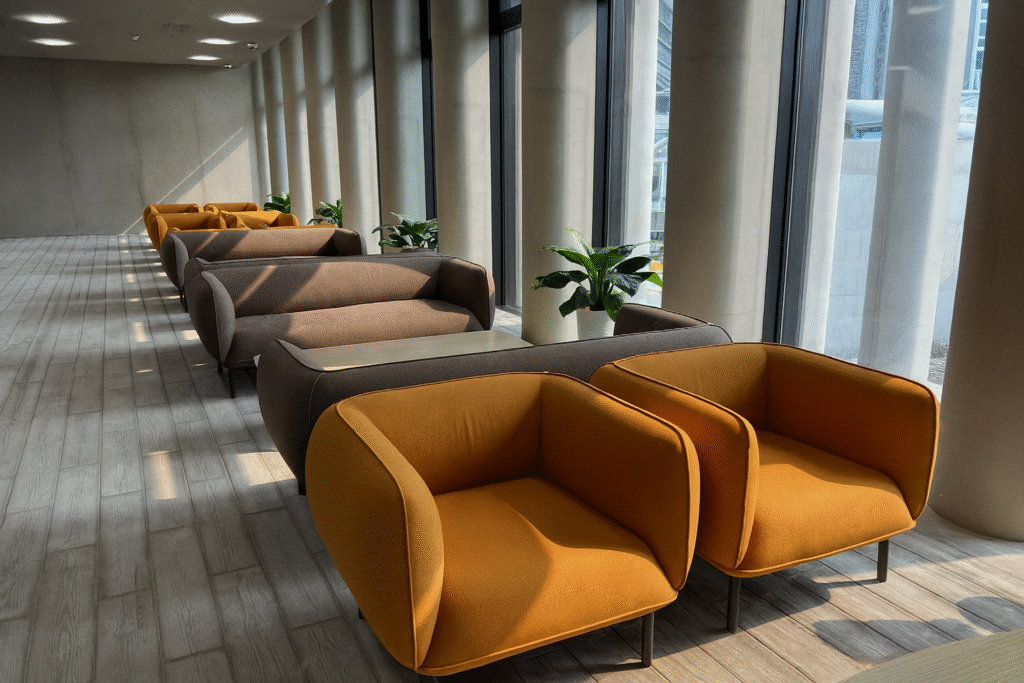
Commercial Upholstery
Curtains & Blinds
Bespoke Upholstery
Bespoke Cushions


Our Location
Address: 63 New King’s Road, Fulham, London, SW6 4SE
Opening time:
Monday – Friday: 9:00am – 5:00pm
Saturday: 9:00am – 4:00pm
Sunday: Closed
Speak with the Team
020 7371 7073
info@finelineupholstery.co.uk
