Fineline Upholstery
Fineline Upholstery
Mid-Century, Chesterfield, or Wingback? Choosing the Right Silhouette for Your Space
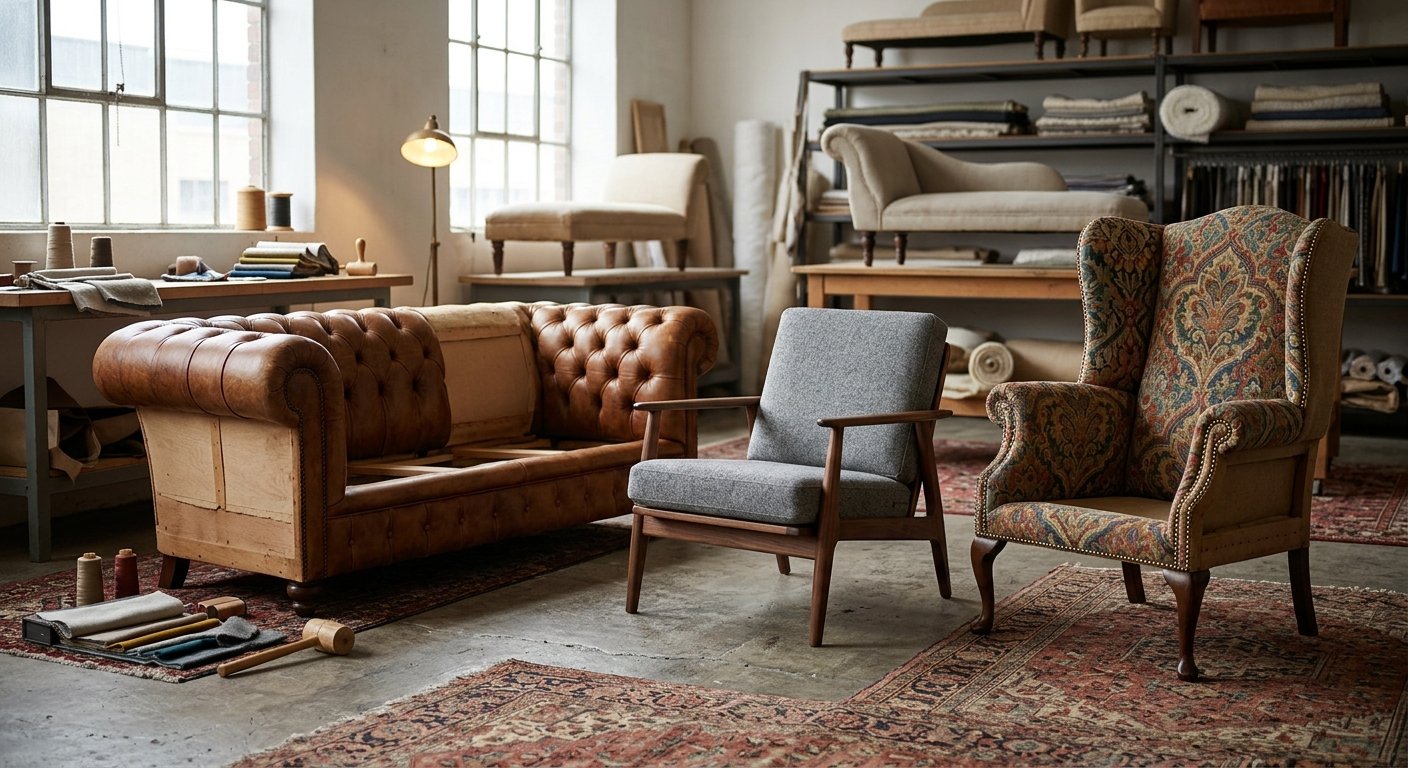
Fabrics fade, and fillings can be renewed, but a silhouette is forever. While outer upholstery and interior padding remain entirely fluid, the foundational frame dictates a piece’s true character. Because this immutable profile cannot be altered once chosen, it remains the single most critical and irreversible decision of any custom upholstery project.
Three silhouettes appear more frequently than any others: the Chesterfield, the mid-century frame, and the wingback. Each was designed for a particular setting, for particular habits of sitting, and in some cases for a particular climate. Understanding the underlying purpose of each shape explains why it performs well in some rooms and awkwardly in others.
The Rooms Have Changed More Than the Furniture
Before considering any individual shape, it is worth noting how much British rooms have evolved. Figures compiled by Statista and reported by Homebuilding put the average living room in a 1970s new-build at approximately 24.9 m², against roughly 17.1 m² in a current new-build. That represents a reduction in space of around a third within a single lifetime.
Ceiling heights follow the same pattern. Victorian rooms commonly stand between 2.7m and 3m, with Georgian drawing rooms often higher still. A modern new-build house is typically built at 2.4m, and new-build flats frequently sit between 2.1m and 2.3m. There is no statutory minimum ceiling height in UK Building Regulations, so the figure is set by construction economics rather than by rule.
These changes in building style and spatial distribution can impact furniture selection. The Chesterfield and the wingback were designed for the taller, larger rooms of their period, while the mid-century frame was developed for the compact post-war housing that replaced them. A shape that appears heavy or overbearing in a given room is generally due to the space in which the furniture has been placed in.
The Chesterfield
The Chesterfield can be traced to the mid-eighteenth century and to Philip Stanhope, the fourth Earl of Chesterfield, who is said to have commissioned a seat that allowed a gentleman to sit upright without creasing his clothing. The defining features are arms that rise to the same height as the back, a rolled profile, and deep buttoning across the back and arms. The deep-set buttoning and coil spring suspension that most people associate with the shape were introduced later, during the Victorian period, around 1828.
Typical proportions are more compact than the shape’s visual weight suggest. A Chesterfield seat depth of around 58cm and a seat height of around 46cm is common, with a two-seater at roughly 180cm wide, a three-seater at about 221cm, and a four-seater at around 242cm. Overall depth of approximately 94cm means the frame occupies less floor area than many contemporary sofas of equivalent seating capacity.
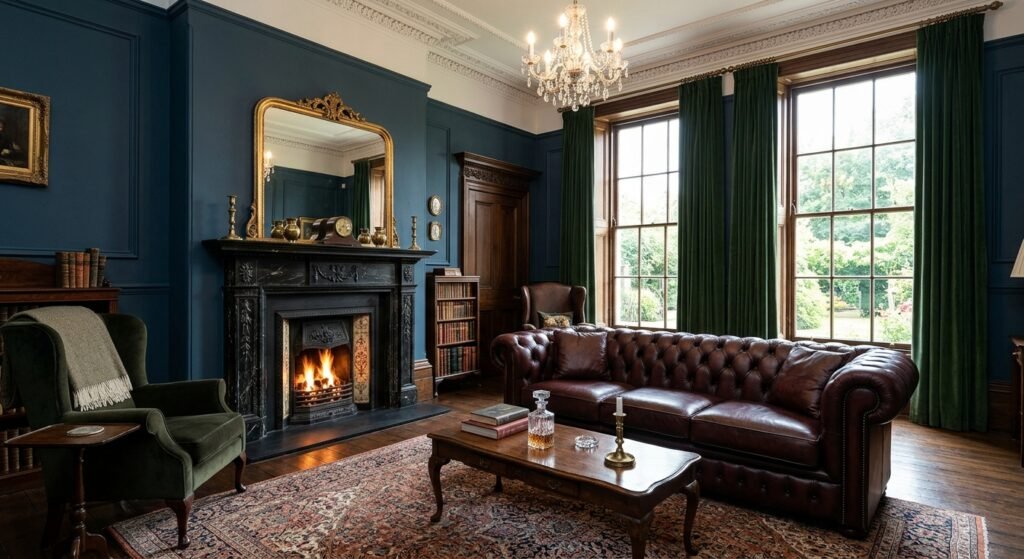
The limiting factor: The Chesterfield has an upright profile to promote posture as opposed to a lounging one. One furniture writer, assessing the shape based on ownership rather than simple observation at a showroom, describes the stiff back section, arms whose upright angle make them firm to rest against, and buttoning that holds a firm structure which does not allow one to relax into. The same assessment notes the shape can suit a person who needs firm upright support, since the back provides exactly that. A household that wants to stretch out and watch television on a Chesterfield will not find a suitable level of comfort to indulge this and this it not an aspect that can be changed through reupholstery, the geometry of the frame is specific to the pieces character.
The Chesterfield resides best in a room which has the height to carry it: Victorian and Georgian reception rooms, panelled studies, and spaces with a substantial fireplace or tall windows. In an apartment or flat with a 2.1mtr high ceiling for example; the same piece can dominate and sometimes overwhelm the room, particularly in darker leathers.
The Mid-Century Frame
Mid-century seating emerged from the post-war housing expansion and results from manufacturing methods developed during the war. Charles and Ray Eames produced moulded plywood chairs in 1946 and fibreglass chairs in 1950, both in very large quantities. Spending on furniture and appliances rose by 240 percent between 1945 and 1949 as new households were formed and furnished. The design philosophy of the period was focused on accessibility, and the homes of this period comprised of smaller rooms. Consequently, designers prioritized clean lines, lightweight materials, and multifunctional furniture pieces that could maximize space without sacrificing aesthetic appeal. This pragmatic yet visionary approach ultimately transformed mid-century seating into an enduring symbol of modern design, whose influence remains just as relevant in today’s compact living spaces.
The characteristics are consistent: tapered legs of roughly 18 to 25cm raising the frame clear of the floor, a seat height of approximately 43 to 51cm, firmer cushioning, slim arms, and a lower back. Each of these choices reduces visual weight. Visible space beneath a frame allows light and floor to continue under the piece giving the illusion of increased space, and a lower back preserves sightlines across a room rather than interrupting them.
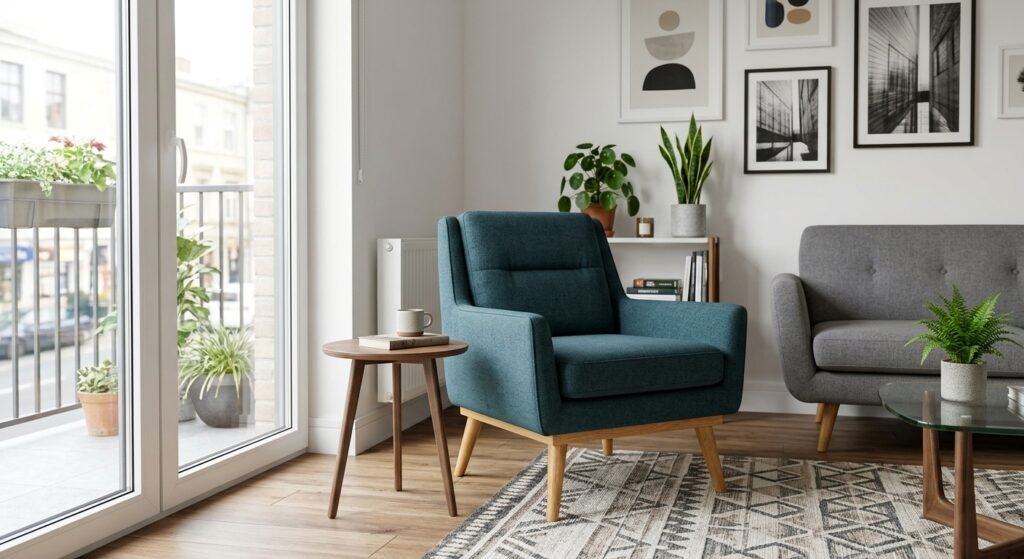
The limiting factor: The firmness and the reduced proportions that make this type of profile suitable for a small room will be limited in comfort for those looking for pieces which will allow for lounging. Heavily filled cushions placed on a mid-century frame will counteract the clean silhouette and potentially leave a piece looking confused and unsightly as it sits between styles. Crisp mid-century profiles coupled with soft enveloping seat and back cushions are generally incompatible, however, with a clear design vision and an understanding of limitations there are mediums that can be found.
Mid-century frames suit modern interiors, flats, and rooms with standard 2.4m ceilings. The raised profile is also practical in rooms where floor area is limited, since furniture that shows its legs makes a room appear less crowded than furniture which sits directly on the floor.
The Wingback
The wingback chair was introduced in England during the 1600s and became widely popular in the 1720s. The wings were functional rather than decorative: they shielded the occupant from draughts and held the warmth of an open fire. An earlier wooden version was used by barber-surgeons, where the wings provided a type of contained space. Remarkably, The basic design has altered little since its initial design.
Typical dimensions run from 107 to 132cm in overall height, 76 to 86cm wide, and 76 to 91cm deep, with a seat height of 43 to 48cm, an arm height of 61 to 69cm, and wings projecting 20 to 30cm. Flat wings and scroll wings are the two common profiles, with bat and butterfly variants also found.
The limiting factor: A wingback silhouette is tall and can cause breaks in sightlines and disrupt the flow of natural light. A floating position in the middle of a room is not recommended, a wingback is much better suited to a comfortable corner where it can almost create its own mini environment, perfect for quiet sitting or reading. In a room with a 2.4m ceiling, a chair from the lower height range generally works well, while the taller frames benefit from the support of tall windows or a substantial chimney breast to look proportionate.
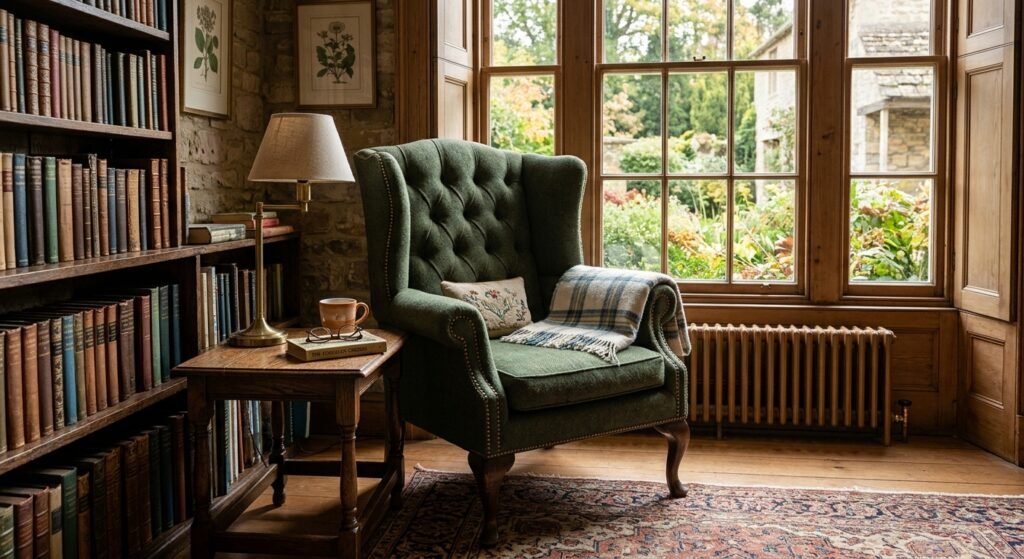
With these mentioned considerations the wingback remains the most practical reading chair of the three shapes, based on its reason for design: the enclosed back and sides create a contained, draught-proof enclosure that encourages peaceful seating.
Two separate decisions are often treated as one. The architecture of the room; ceiling height and floor area, determines which silhouette will read correctly in the space. The habits of the people using the furniture determine the seat depth and firmness requirements. A particular piece can be correct for a room and wrong for a household, and the reverse is equally common.
Seat Depth: Where Comfort Is Actually Decided
Once the silhouette suits the room, seat depth determines whether the piece suits the functional requirements of the household. Published guidance divides the range into bands. A shallow seat of 50 to 55cm suits shorter adults, reading, and working on a laptop, and makes standing up easier. A standard seat of 55 to 62cm suits most mixed households. A deep seat of 62 to 70cm suits taller adults lounging and television watching. Anything beyond 70cm seat depth is a sofa for sprawling and napping, and requires the floor space to carry it.
A simple check settles most concerns. Sitting fully back in the seat, the feet should reach the floor, and roughly two fingers should fit between the front edge of the seat and the back of the knee. A seat that fails this test will be uncomfortable regardless of the quality of the filling, this relates to the frame and cushion dimensions rather than the upholstery.
Matching the Silhouette to the Interior
Traditional interiors: period rooms with higher ceilings, cornicing, and fireplaces carry the Chesterfield and the wingback comfortably. Both shapes were designed for rooms of this type, and the proportions correspond to the architecture around them.
Modern interiors: flats, new-builds, and open-plan spaces generally suit mid-century frames, where the raised frame and lower back keep sightlines open across a room that has no walls dividing it. A single wingback can still work in a modern room, provided it is placed in a corner rather than in a section of open space.
Transitional interiors: examples of this can be seen where a period property contains contemporary furnishings or a modern property contains inherited pieces. Here a single traditional silhouette among simpler frames tends to work better than an even mixture of both. A Chesterfield reupholstered in a plain modern weave rather than buttoned leather, or a wingback with the buttoning omitted, carries the historical shape without the period styling that would conflict with the rest of the room.
How We Approach Silhouette at Fineline Upholstery
Most of our work involves a piece that a client already owns or has recently acquired, as a result the decision regarding the silhouette is usually made before our work begins. The question then becomes whether the shape suits the room it is going into and the way it will be used, and whether reupholstery can reasonably close any gap between the two.
We can provide clarity regarding what reupholstery will and will not change. Fabric, padding, suspension, and finishing details are all open to revision. Seat depth can sometimes be adjusted to a degree through the cushion specification. The height of a back, the angle of an arm, and the overall footprint are determined by the frame and stay as they are; slight modification is possible but is completely dependent on the piece itself. When a client is unhappy with how a piece feels rather than its look, our assessment determines whether the issue lies in the padding or the frame itself, as only one can be modified.
Finishing details can be adjusted to synergise a traditional frame with a contemporary room. Buttoning can be reduced or omitted, piping can be matched rather than contrasted, and the choice of upholstery fabric can shift a Chesterfield considerably away from its club-room aesthetics. The selection of fabric remains the client’s decision, made with our guidance on how each option suits the frame and the setting.
If you are deciding between silhouettes or wondering whether an existing piece suits a new room, send us photographs of the furniture and of the space it is going into, including the ceiling line, and let us know how the seat will be used day to day. We can set out which options would work, what changes can be made through reupholstery , and what would remain fixed.
Our Services
Headboards/ Bedframes
Bespoke Loose Covers
Commercial Upholstery
Curtains & Blinds
Bespoke Upholstery
Bespoke Cushions
EXCELLENTTrustindex verifies that the original source of the review is Google. Fineupholstery are wonderful. I have used their services before. I took in an old and very interesting chair for them to re-cover. It was quite complicated and they have done an excellent job. I am thrilled with the new look. And they were so helpful with fabric choice. I felt looked after and will happily to continue using their expert recovering services again. Thank you to all.Posted on GoogleTrustindex verifies that the original source of the review is Google. I contacted Fineline Upholstery to ask for some help with a damaged sofa. They were very prompt, asked for all the necessary details in one email so that once that was provided they could provide a quote and then come and carry out the work. It was effortless and I am very happy with their speed and professionalism. I would definitely use them again.Posted on GoogleTrustindex verifies that the original source of the review is Google. Excellent service and beautifully reupholstered armchair. Top job from beginning to end. Thank you!Posted on GoogleTrustindex verifies that the original source of the review is Google. Friendly, reliable and excellent craftsmanship! Thanks v much :) love our “new” furniturePosted on GoogleTrustindex verifies that the original source of the review is Google. It’s not just the quality of the upholstery, which is absolutely outstanding, but also the excellent customer service. All done really efficiently with updates at every stage.Posted on GoogleTrustindex verifies that the original source of the review is Google. It was a pleasure dealing with Fineline Upholsterers. Their work is of the highest standard and we were delighted with their speedy, prompt and excellent service. I would highly recommend them.Posted on GoogleTrustindex verifies that the original source of the review is Google. I dumped a whole pile of unsatisfactory sofa seat cushions in the workshop. 2 weeks later they were delivered home all pristine and plumped. So easy. So efficient. I can’t wait for my next project!Posted on GoogleTrustindex verifies that the original source of the review is Google. Highly recommended! Fineline Upholstery could not have done more to help. We had a bed that unfortunately got damaged during a house move. Collection, return and reassembly were all carried out efficiently and professionally. The quality of the reupholstered bed could not have been better. We will certainly use again.Posted on GoogleTrustindex verifies that the original source of the review is Google. Excellent service courteous and extremely efficient. Thank you Min. Delighted with the cushions beautifully made and ready much earlier than expected. Thank you Chris.Posted on GoogleTrustindex verifies that the original source of the review is Google. Can’t recommend this company highly enough! Have now used them twice: re-padding and re-upholstery of antique dining chairs and re-upholstery of new chaise. The results were brilliant, excellently made and the customer service responsive, attentive and very efficient. Prices are fair and reasonable. Thankyou!



Our Location
Address: 63 New King’s Road, Fulham, London, SW6 4SE
Opening time:
Monday – Friday: 9:00am – 5:00pm
Saturday: 9:00am – 4:00pm
Sunday: Closed
Speak with the Team
020 7371 7073
info@finelineupholstery.co.uk
