Fineline Upholstery
Fineline Upholstery

Indoor vs. Outdoor Seating: Why Garden and Sunroom Furniture Needs Special Consideration
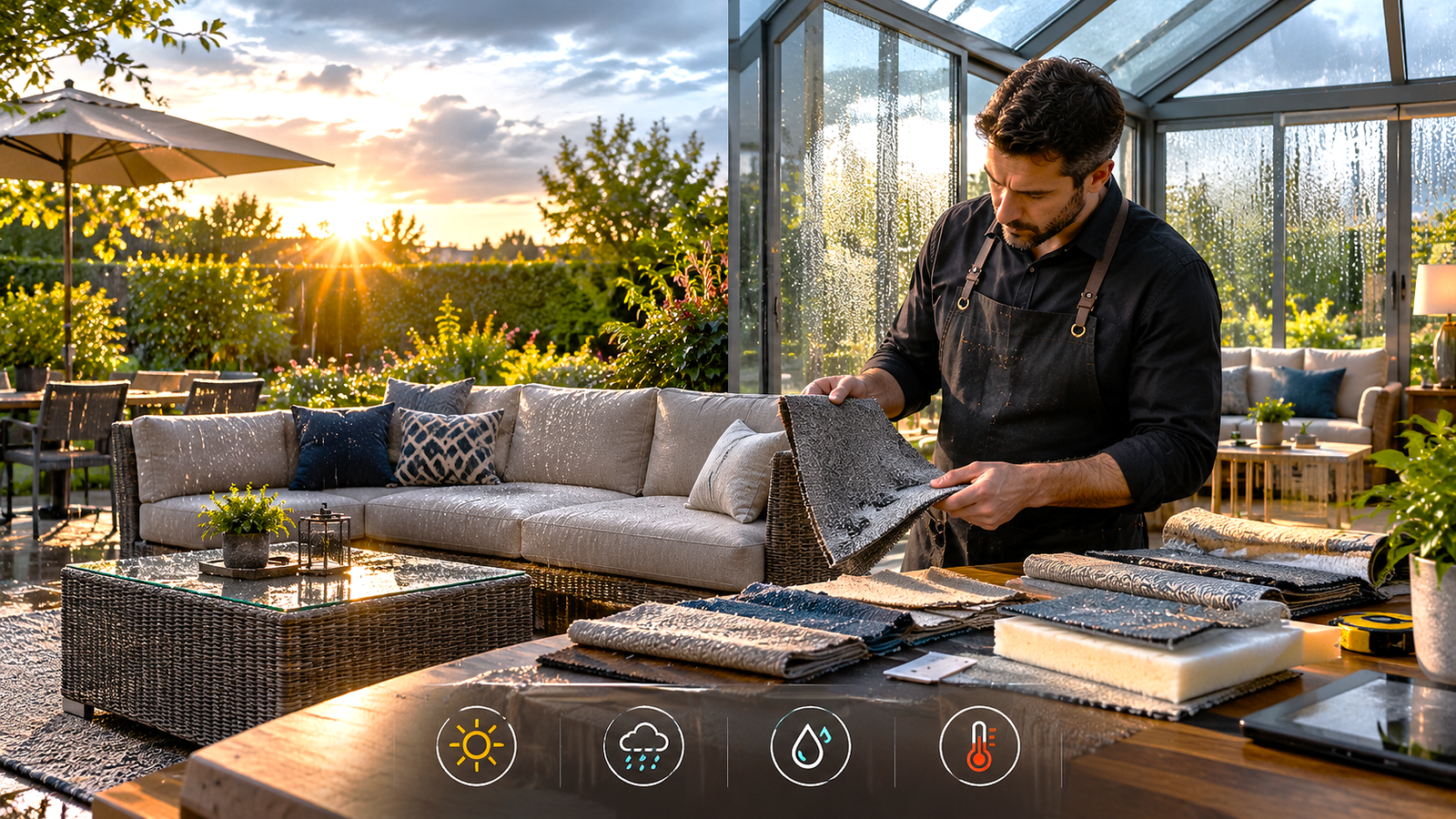
Upholstery made for a sitting room is constructed for stable conditions: moderate temperatures, controlled humidity, and daylight that reaches furniture through a window for part of the day. Garden and sunroom furniture is subject to a completely different environment. Outdoor seating is exposed to sustained ultraviolet light, repeated rain, overnight condensation, and temperature variances that indoor materials are not designed to tolerate. When unsuitable fabric is used for outdoor seating, the results tend to follow a consistent pattern: discolouration, split seams, and damp inner cushions that develop mildew within a season or two.
This article examines why standard indoor fabrics and fillings generally perform poorly against the elements and sets out which materials can be expected to perform better. It also addresses a distinction that is often overlooked: a conservatory is not an outdoor space, and the requirements for each are not the same.
Moisture: The Primary Concern in the UK
Outdoor furniture in the UK is exposed to rain more often than to strong sun. Met Office averages for 1991 to 2020 record around 159 days a year with at least one millimetre of rain or snow across the UK, totalling roughly 1,163 millimetres. London is drier than the national average, at around 114 wet days and 628 millimetres a year, but even in the south-east a cushion left outside can be expected to be rained on roughly one day in three.
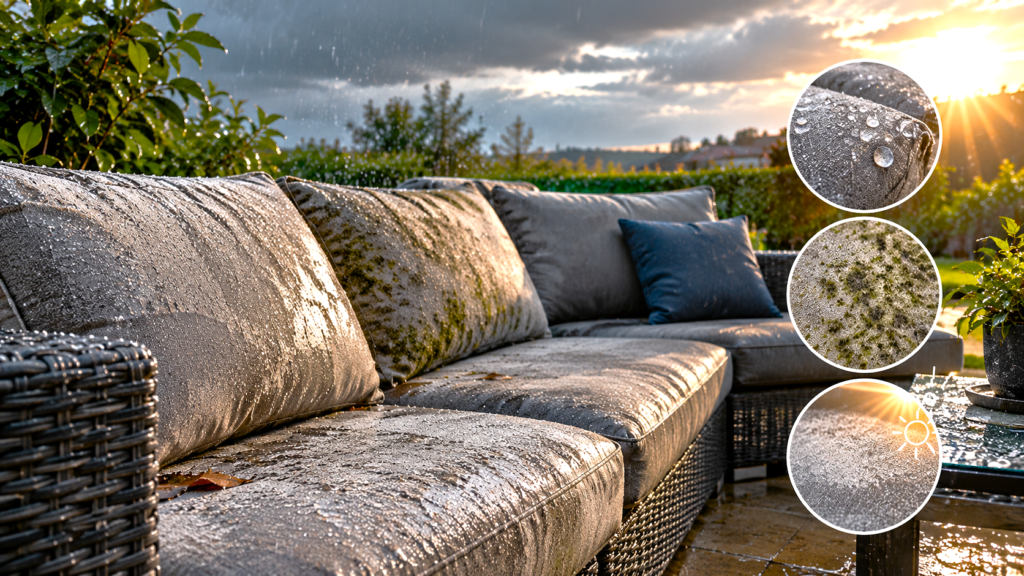
Rain is only part of the picture. Dew forms on clear nights through spring and autumn, and humidity often remains high for long periods, particularly in the mild weeks either side of winter. Temperatures of around 8 to 12°C combined with high humidity provide close to ideal conditions for mildew, which is why UK retailers of garden furniture report that cushions stored away that are damp in September are frequently spotted with mould by November.
Research from the Canadian Conservation Institute shows how sharply the risk rises with humidity. At around 25°C, visible mould can take roughly 100 days to appear at 70 percent relative humidity, but as little as two days at 90 percent. The material matters as much as the climate. Cotton and linen are hygroscopic, meaning they absorb moisture quickly and release it slowly, and the Smithsonian’s Museum Conservation Institute notes that stagnant air above 80 percent relative humidity can result in mould on both types of material. Synthetic fibres such as polyester absorb very little moisture by comparison.
Soiling lowers the threshold further. Food residue, body oils, pollen, and leaf debris provide nutrients that mould would not otherwise be exposed to on the fabric. An indoor air-quality investigator in the United States found mould on church pew cushions almost entirely in the rows where families had left snack and juice residue.
Ultraviolet Light: Why Fading Cannot Be Reversed
Colour loss in fabric is caused by ultraviolet light breaking down the dye molecules responsible for colour, this process is known as photodegradation. Around 98.8 percent of the ultraviolet radiation that reaches ground level is UVA which passes through standard glass. For this reason, it is very common for furniture in conservatories and sunrooms to fade even though it is never rained on, and why fading continues throughout the year rather than only in summer.
Once the dye has broken down, the colour cannot be restored through cleaning or treatment. The only remedy for a faded cover is replacement. Ultraviolet light also weakens fibres and threads, fabric exposed to prolonged sunlight exposure can become brittle and lose weave integrity before fading occurs. Leather in a sunlit room is affected in a similar way and also tends to dry and crack. Faded leather can in some cases be re-dyed by a specialist, though this is a restoration process rather than routine maintenance.
Heat and Condensation in Sunrooms
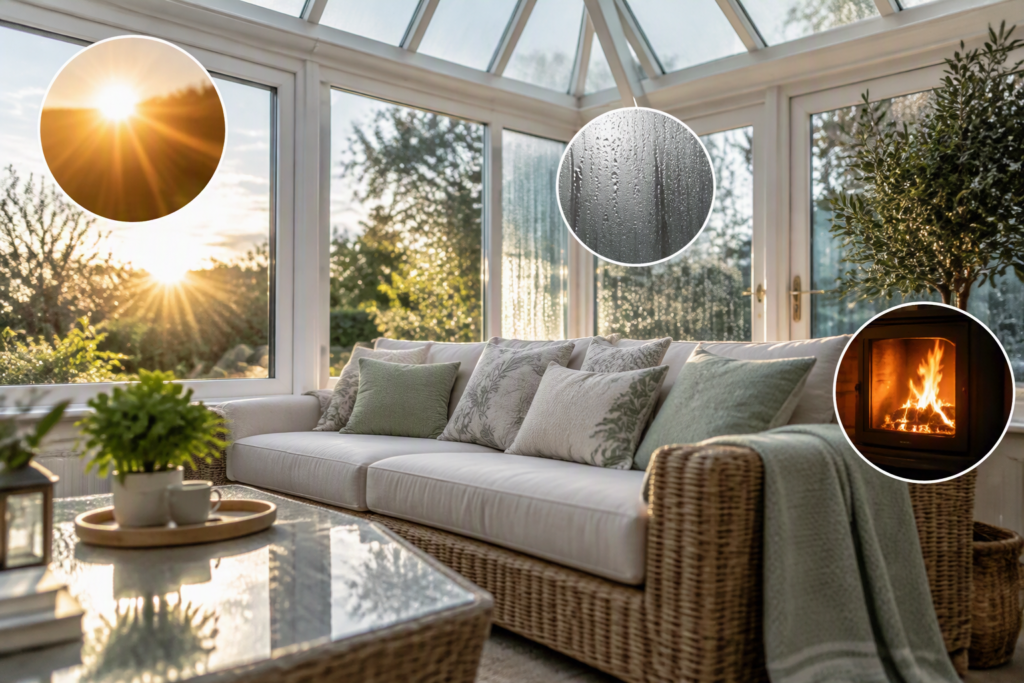
Conservatories and sunrooms add yet another aspect to plan against: temperature swings. UK conservatory installers report that on a 25°C day, a conservatory with an older polycarbonate or basic glass roof can reach 40°C or more inside, and the room can retain warmth well into the evening.
In winter the pattern reverses. Glass cools quickly, warm moist air condenses on it, and humidity in an unheated or intermittently heated conservatory can rise well above the 50 to 55 percent generally recommended for such rooms. Condensation that is not managed can lead to mould on blinds and soft furnishings as well as on frames and glazing. A sunroom therefore places sustained light and heat stress on upholstery in summer and moisture stress in winter, which is a combination few indoor rooms produce.
A conservatory is not an outdoor space. Sunroom furniture is exposed to UV through glass, heat, and seasonal condensation, but it is not rained upon. Garden furniture is exposed to all of these and to repeated soaking as well. The materials which suit one are not always the right choice for the other, and, as set out below, the fire safety position can differ too.
Outdoor Fabrics: How They Differ from Indoor Upholstery
The most significant difference between indoor and outdoor fabric is how the colour is applied. Most indoor upholstery is dyed or printed after the yarn or cloth is made, so the colour sits on or near the surface of the fabric. Outdoor fabrics are generally solution-dyed: pigment is added to the liquid polymer before the fibre is spun, so the colour runs through the whole fibre rather than just coating it.
Solution-dyed acrylic: This is the reference material for fully exposed outdoor seating. Quality solution-dyed acrylics typically achieve light-fastness ratings of 7 to 8 on the 1 to 8 scale, compared with 5 to 6 for most performance polyesters and olefins. Sunbrella and Outdura, the two most widely specified ranges, are rated at 1,500 light hours or more, and many Sunbrella fabrics at 2,000 or more. The fibre is breathable, dries quickly, and does not itself support mildew, though mildew can still form on dirt and organic residue left on the surface. It costs more than the alternatives and has a slightly firmer texture and weave compared with most indoor fabrics.
Olefin (polypropylene): Olefin is solution-dyed by nature, absorbs almost no water, dries quickly, and is highly stain resistant. It is also one of the few upholstery fibres that tolerates cleaning with bleach. It is less tolerant of prolonged, intense heat and ultraviolet light than acrylic and over several years in full sun the fibre can harden. It generally has a slightly waxier, more synthetic feel. For covered terraces and partially shaded seating, it can be a reasonable lower-cost choice.
Polyester: Polyester present the most variation of the three. Printed or surface-dyed polyester can fade noticeably within a season or two if used outdoors. Solution-dyed, UV-treated polyester performs considerably better and is a sensible mid-range option for covered spaces, partial shade, and sunrooms, provided it is not expected to withstand the same exposure as acrylic.
Natural fibres such as cotton, linen, wool, and silk are generally unsuitable for permanent outdoor use. They fade faster, absorb moisture, and support mildew at lower humidity than synthetics. In a sunroom they can be used with care, provided the fabric carries a suitable light-fastness rating and the room’s light and humidity are managed.
Abrasion should also be a strong consideration when choosing outdoor fabric; industry guidance commonly suggests a minimum of around 30,000 Martindale rubs for outdoor seating and 50,000 or more for heavily used outdoor dining chairs.
Fillings: Why Standard Foam Holds Water
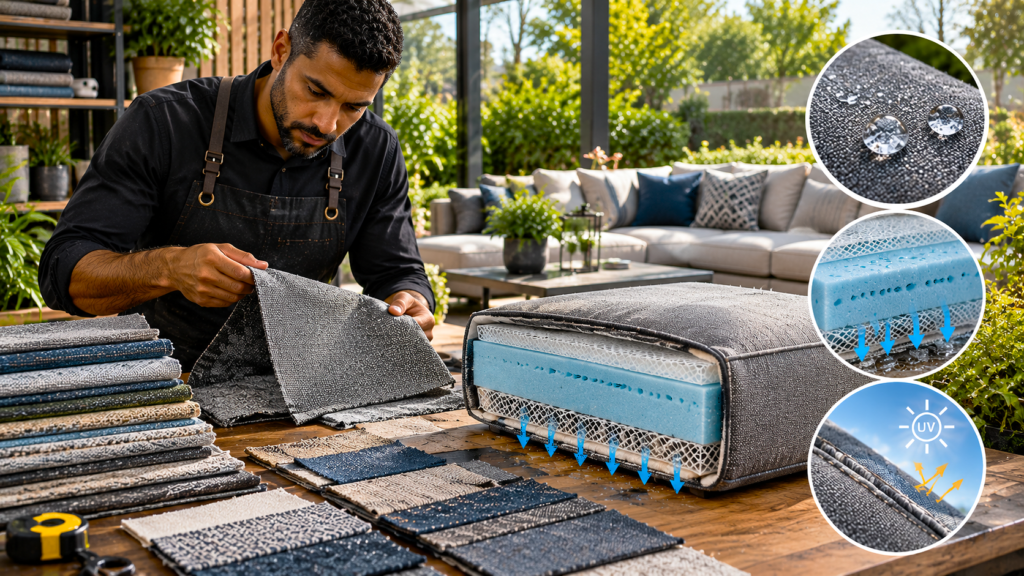
The filling is where most outdoor cushions fail, even when the fabric is suitable. Standard upholstery foam holds water within its cell structure. A cushion that has been soaked through can remain damp at its core for several days, even when the surface fabric feels dry. Sitting on damp foam compresses it faster and shortens its life and the trapped moisture provides the conditions for mould and odour.
Feather and down are unsuitable for the same reason in a more pronounced way. Once wet, they clump, dry slowly, and are difficult to dry fully in a garden setting. The foam core with feather wrap that suits many indoor sofas is a highly inappropriate construction for cushions that will be left outside.
Reticulated (quick-dry) foam: Quick-dry foam, also known as reticulated foam, is made by removing the cell walls from the foam during manufacture, leaving an open, skeletal structure with a porosity typically in the region of 95 to 98 percent. Water drains through the foam rather than being held in it, and air circulates freely, so the cushion can dry within hours rather than days. Many grades also include an antimicrobial or fungicidal additive to slow mildew and odour.
Quick-dry foam has limitations that are worth stating. Suppliers note that a high-density foam, once reticulated, generally behaves more like a medium-density grade, and they recommend it for occasional-use seating rather than daily use. It is available in medium and firm grades, but the feel is firmer and slightly coarser than the indoor foam most people are used to. This type of foam only performs as intended if the rest of the cushion allows water to escape; a quick-dry core inside a cover with no drainage path, or wrapped in a layer that holds water, will not dry as quickly. A breathable mesh panel on the underside of the cushion is often used for this reason.
Thread and Seams: Often the First Point of Failure
Outdoor cushions frequently split at the seams before the fabric shows significant wear. A representative of W.L. Gore told the trade publication Marine Fabricator that polyester and cotton threads can lose as much as 50 percent of their strength in their first year of sun exposure. UV-treated polyester thread is commonly used for outdoor cushions and performs adequately in moderate exposure, but thread specialists caution against relying on it for pieces expected to last more than two or three years in full sun. Polyester thread is also weakened by bleach, which is relevant because many outdoor fabrics are cleaned with a diluted bleach solution.
PTFE threads, such as Tenara, are unaffected by ultraviolet light, salt, and cleaning chemicals, and typically carry a guarantee of 15 years or longer. They cost more and are more demanding to sew, but for cushions that will remain outside for most of the year, they address a major issue which causes outdoor upholstery to fail.
Fire Safety: Conservatory Furniture Is Covered by the Regulations
A point that is often overlooked is that the Furniture and Furnishings (Fire) (Safety) Regulations 1988 are not limited to indoor furniture. They apply to upholstered garden furniture that is suitable for use in a dwelling, including conservatories. Trading Standards guidance gives upholstered dining sets for use in conservatories and gardens as a specific example. The regulations do not apply to garden furniture that is unsuitable for use in a dwelling.
In practice, this means upholstered seating intended for a conservatory or sunroom must meet the same requirements as indoor furniture: the cover must pass the match test, the filling must meet the relevant ignition requirements, and the composite must pass the cigarette test. Not every outdoor fabric or quick-dry foam carries the necessary certification, which narrows the available choice for conservatory pieces. For hospitality and commercial settings, requirements are set out separately and should be confirmed for the specific venue.
Care and Storage
The most common cause of damage to outdoor cushions is storage rather than use. Cushions should be stored completely dry, in a ventilated space, standing upright rather than stacked, and off the ground. Sealed plastic bags trap residual moisture and generally cause more harm than good; breathable bags or a ventilated storage box are preferable. Where cushions are left on the furniture, a vented cover positioned so that water runs off is more effective than a fully waterproof one that traps condensation beneath it.
Brushing away leaves and debris, cleaning spills promptly, and rinsing fabric thoroughly after cleaning all reduce the soiling that mildew thrives on. In a conservatory, blinds, UV-reducing window film, and regular rotation of cushions reduce light exposure, while ventilation and, where necessary, a dehumidifier in winter keep condensation under control.
How We Approach Outdoor and Sunroom Upholstery at Fineline Upholstery
We begin by establishing where the piece will actually sit. A fully exposed garden, a covered terrace, or a conservatory each place different demands on fabric and filling, and a recommendation made without that information often leads to disappointment. We ask which direction the space faces, how much direct sun it receives through the day, and whether the cushions can realistically be brought in over winter.
For fully exposed garden seating, we generally advise solution-dyed acrylic covers, quick-dry foam, UV-resistant thread, and a construction that allows water to drain. We explain in advance that quick-dry foam feels firmer than indoor foam and is better suited to occasional use, so that clients who expect the comfort of a sitting room sofa are not surprised by the difference.
For covered terraces and partially shaded spaces, solution-dyed polyester or olefin can be a reasonable and more economical choice, provided the furniture is not in prolonged direct sun. For conservatories and sunrooms, the main concerns are ultraviolet light and heat rather than rain. Here we guide clients towards fabrics with higher light-fastness ratings than would be needed elsewhere in the house, and we confirm fire safety certification for the cover and filling before anything is ordered. In a well-ventilated conservatory where condensation is managed, conventional upholstery foam and cushion constructions can be appropriate.
We can provide clarity regarding what outdoor materials can and cannot do. No fabric is immune to fading; solution-dyed acrylic slow fading considerably but does not prevent it entirely. Even the most suitable materials will last noticeably longer when cushions are dried and stored properly over the colder months. The final choice of fabric remains with the client; our role is to set out how each option can be expected to perform in the specific location.
Where existing garden or conservatory cushions have failed, we assess whether the cover, the filling, or both need replacing. Sound frames, such as well-kept rattan or hardwood garden furniture, can often be re-cushioned without replacing the piece itself. We hold samples of outdoor fabrics and quick-dry foam so clients can compare the feel and weight against indoor materials before deciding.
If you are planning seating for a garden, terrace, or conservatory, send us photographs of the space and the furniture, and let us know how the pieces will be used. We can advise which fabrics and fillings suit those conditions and show you samples before anything is ordered.
Our Services
Headboards/ Bedframes
Bespoke Loose Covers
Commercial Upholstery
Curtains & Blinds
Bespoke Upholstery
Bespoke Cushions
EXCELLENTTrustindex verifies that the original source of the review is Google. Fineupholstery are wonderful. I have used their services before. I took in an old and very interesting chair for them to re-cover. It was quite complicated and they have done an excellent job. I am thrilled with the new look. And they were so helpful with fabric choice. I felt looked after and will happily to continue using their expert recovering services again. Thank you to all.Posted on GoogleTrustindex verifies that the original source of the review is Google. I contacted Fineline Upholstery to ask for some help with a damaged sofa. They were very prompt, asked for all the necessary details in one email so that once that was provided they could provide a quote and then come and carry out the work. It was effortless and I am very happy with their speed and professionalism. I would definitely use them again.Posted on GoogleTrustindex verifies that the original source of the review is Google. Excellent service and beautifully reupholstered armchair. Top job from beginning to end. Thank you!Posted on GoogleTrustindex verifies that the original source of the review is Google. Friendly, reliable and excellent craftsmanship! Thanks v much :) love our “new” furniturePosted on GoogleTrustindex verifies that the original source of the review is Google. It’s not just the quality of the upholstery, which is absolutely outstanding, but also the excellent customer service. All done really efficiently with updates at every stage.Posted on GoogleTrustindex verifies that the original source of the review is Google. It was a pleasure dealing with Fineline Upholsterers. Their work is of the highest standard and we were delighted with their speedy, prompt and excellent service. I would highly recommend them.Posted on GoogleTrustindex verifies that the original source of the review is Google. I dumped a whole pile of unsatisfactory sofa seat cushions in the workshop. 2 weeks later they were delivered home all pristine and plumped. So easy. So efficient. I can’t wait for my next project!Posted on GoogleTrustindex verifies that the original source of the review is Google. Highly recommended! Fineline Upholstery could not have done more to help. We had a bed that unfortunately got damaged during a house move. Collection, return and reassembly were all carried out efficiently and professionally. The quality of the reupholstered bed could not have been better. We will certainly use again.Posted on GoogleTrustindex verifies that the original source of the review is Google. Excellent service courteous and extremely efficient. Thank you Min. Delighted with the cushions beautifully made and ready much earlier than expected. Thank you Chris.Posted on GoogleTrustindex verifies that the original source of the review is Google. Can’t recommend this company highly enough! Have now used them twice: re-padding and re-upholstery of antique dining chairs and re-upholstery of new chaise. The results were brilliant, excellently made and the customer service responsive, attentive and very efficient. Prices are fair and reasonable. Thankyou!


Our Location
Address: 63 New King’s Road, Fulham, London, SW6 4SE
Opening time:
Monday – Friday: 9:00am – 5:00pm
Saturday: 9:00am – 4:00pm
Sunday: Closed
Speak with the Team
020 7371 7073
info@finelineupholstery.co.uk
