UK fire safety regulations for upholstered furniture distinguish clearly between domestic and commercial applications, each with different testing standards. Confusion between these standards remains common, particularly when furniture is intended for business use, holiday lettings, or hospitality. Understanding which standard applies and which materials meet those standards prevents non-compliance and legal liability.
This article examines UK fire safety regulations, clarifies the distinction between domestic and commercial standards, and provides practical guidance on FR-compliant materials available to meet various and specific requirements.
The Furniture and Furnishings (Fire) (Safety) Regulations 1988 (amended 1989, 1993, 2010, and 2025) established mandatory fire safety requirements for upholstered furniture in the UK. Since implementation, fatal domestic furniture fires have significantly decreased. The regulations apply to all persons supplying fabrics, filling materials, or reupholstery services. The most recent 2025 amendment removed display labelling requirements at point of sale, extended enforcement timeframes to 12 months, and removed certain infant and baby products from scope.
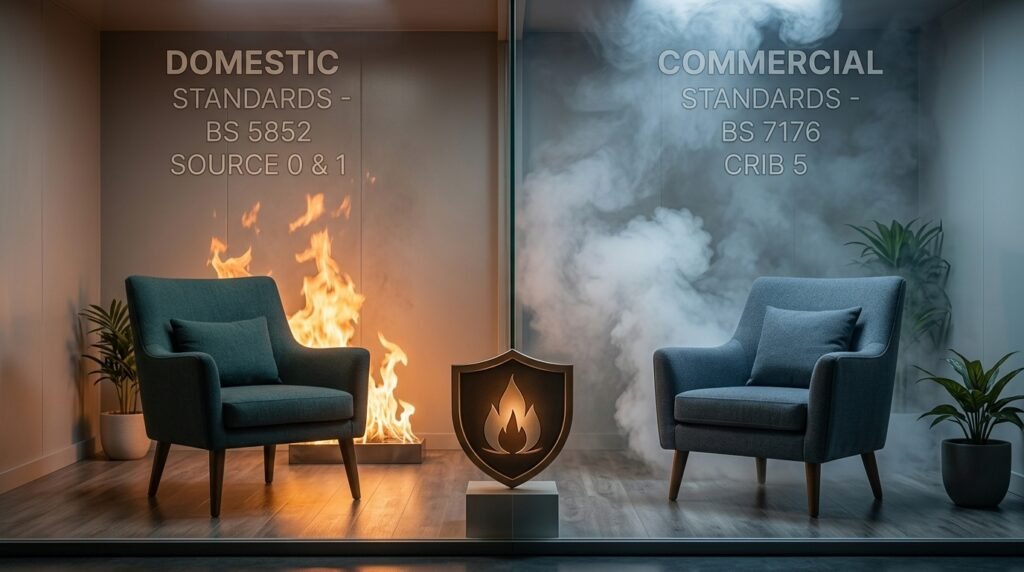
Domestic furniture must pass two tests: Source 0 (cigarette test) places a smouldering cigarette in the seat-back junction; the material must not smoulder after one hour or show charring beyond 100mm. Source 1 (match test) applies a small flame for 20 seconds; no flaming is permitted beyond 120 seconds after removal. Both tests apply to the composite assembly cover fabric, filling, and interliner combined.
Neither the fabric nor the interliner layer can pass the cig / match test unless the complete composite passes both tests. BS 5852 compliance is a legal requirement for all domestic UK furniture manufactured after 1 January 1950.
Commercial environments (hotels, restaurants, bars, theatres, hospitals, public buildings) require BS 7176 Medium Hazard compliance, which means Crib 5 (Source 5) testing. This test uses a standardised wooden crib creating intense flame and heat, substantially more demanding than domestic standards.
Critical caveat: BS 5852 requires water-soak testing as part of full Crib 5 certification. Many fabrics pass dry testing but fail when retested after soaking. Indicative certificates without water-soak data are incomplete and unsuitable for contract projects.
Fundamental distinction: Domestic standards require Source 0 and Source 1 testing only. Commercial standards require Crib 5 testing. These are not equivalent. Domestic-standard fabric does not meet commercial requirements.
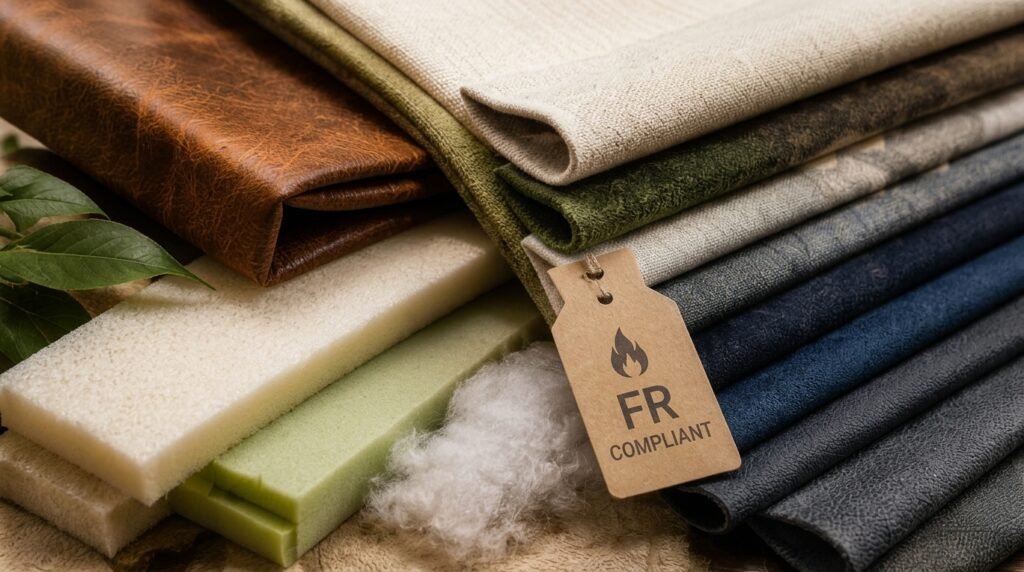
Inherently Flame-Resistant (IFR) Fabrics: Manufactured from fibres naturally resistant to ignition; no chemical treatment required. IFR polyester passes Crib 5 without coatings, avoiding degradation risk and maintaining properties throughout the fabric’s lifespan. Typically softer than treated alternatives.
Topically Treated/Back-Coated Fabrics: Chemical treatment applied to fabric creates fire resistance across broader material ranges (cotton, linen, wool, synthetics), offering more aesthetic flexibility. However, water-soak testing is mandatory; many treated fabrics fail after water-soak despite dry Crib 5 passes. Indicative certification without water-soak data is incomplete.
Natural Fibre FR Options: Cotton, linen, and wool available with FR properties through inherent versions or back-coating. Typically higher cost than untreated versions. Some blends mix FR synthetic with natural fibres without coating.
Leather: Real leather typically passes Source 0 and Source 1 naturally without treatment, making it compliant for domestic use. For commercial (Crib 5), specific types or treatments may be required, confirm through testing documentation.
FR Interliners: Positioned between cover and filling, FR interliners help achieve match test compliance. Various weights are available; selection depends on cover fabric and fill material. An FR interliner can allow a non-FR cover fabric to pass the match test, provided the complete composite passes the cigarette test.
Filling Materials: High-density polyurethane foam, polyester fibrefill, and treated wool are available with FR certification. Low-density or untreated foam may not meet requirements. Filling works in combination with cover and interliner.
Composite Assembly: Regulations test the complete assembly: fabric, interliner, and filling. Different combinations achieve compliance through different strategies. For example, a non-FR fabric paired with FR interliner and compliant filling may pass, or FR fabric with standard interliner may work. Upholsterers and suppliers often provide tested composite data confirming which specific combinations pass BS 5852 requirements.
Domestic use: Private homes, rentals, holiday lets, self-catering accommodation. Require BS 5852 Source 0 and Source 1 only.
Commercial use: Hotels, restaurants, theatres, hospitals, public buildings. Require Crib 5 (Source 5) compliance. Domestic-standard fabric does not meet these requirements.
Holiday lettings and rentals: Typically classified as domestic use (Source 0 and Source 1). Some property owners opt to meet commercial standards for enhanced safety and insurance recognition, though this is not legally required.
All new domestic furniture must carry permanent labels indicating compliance. For reupholstery work, the upholsterer becomes the first UK supplier and must maintain compliance records for five years, documenting materials used and their certifications. When customers supply fabrics, certification must be confirmed before proceeding.
We begin by identifying whether furniture is intended for domestic or commercial use, then specify materials to meet appropriate standards. We are transparent about compliance requirements and the legal and insurance risks of using incorrect standards.
For domestic projects, we recommend fabrics and materials meeting BS 5852 Source 0 and Source 1, presenting options from cost-accessible to premium IFR fabrics. We explain the characteristics of inherently flame-resistant fabrics (consistent performance, no degradation risk) versus treated fabrics (broader aesthetics, water-soak testing considerations).
For commercial projects, we verify full Crib 5 certification including water-soak testing. Indicative results without complete water-soak data are not suitable for contract specifications.
When customers supply their own fabric, FR certification needs to be established and provided. If certification is unavailable, we can recommend FR alternatives matching the aesthetic characteristics of the preferred fabric where possible. We hold samples so clients can assess appearance, texture, and drape before final decisions.
We also discuss interliner and filling material combinations and how these work together with the cover fabric to achieve compliance.
If you are planning upholstery work and are uncertain which fire safety standards apply to your project, which FR fabrics suit your aesthetic preferences, or which material combinations will deliver compliance, send us photographs and let us know what the furniture is, where it will be used, and what design aspects are important to you. We can assess requirements, recommend appropriate materials meeting both compliance and aesthetic needs, and show you samples to confirm that the selection will deliver the result you’re seeking.
Our Location
Address: 63 New King’s Road, Fulham, London, SW6 4SE
Opening time:
Monday – Friday: 9:00am – 5:00pm
Saturday: 9:00am – 4:00pm
Sunday: Closed
Speak with the Team
020 7371 7073
info@finelineupholstery.co.uk